A Level Physics Tutor | 1-to-1 Online Physics Tuition for Years 12–13
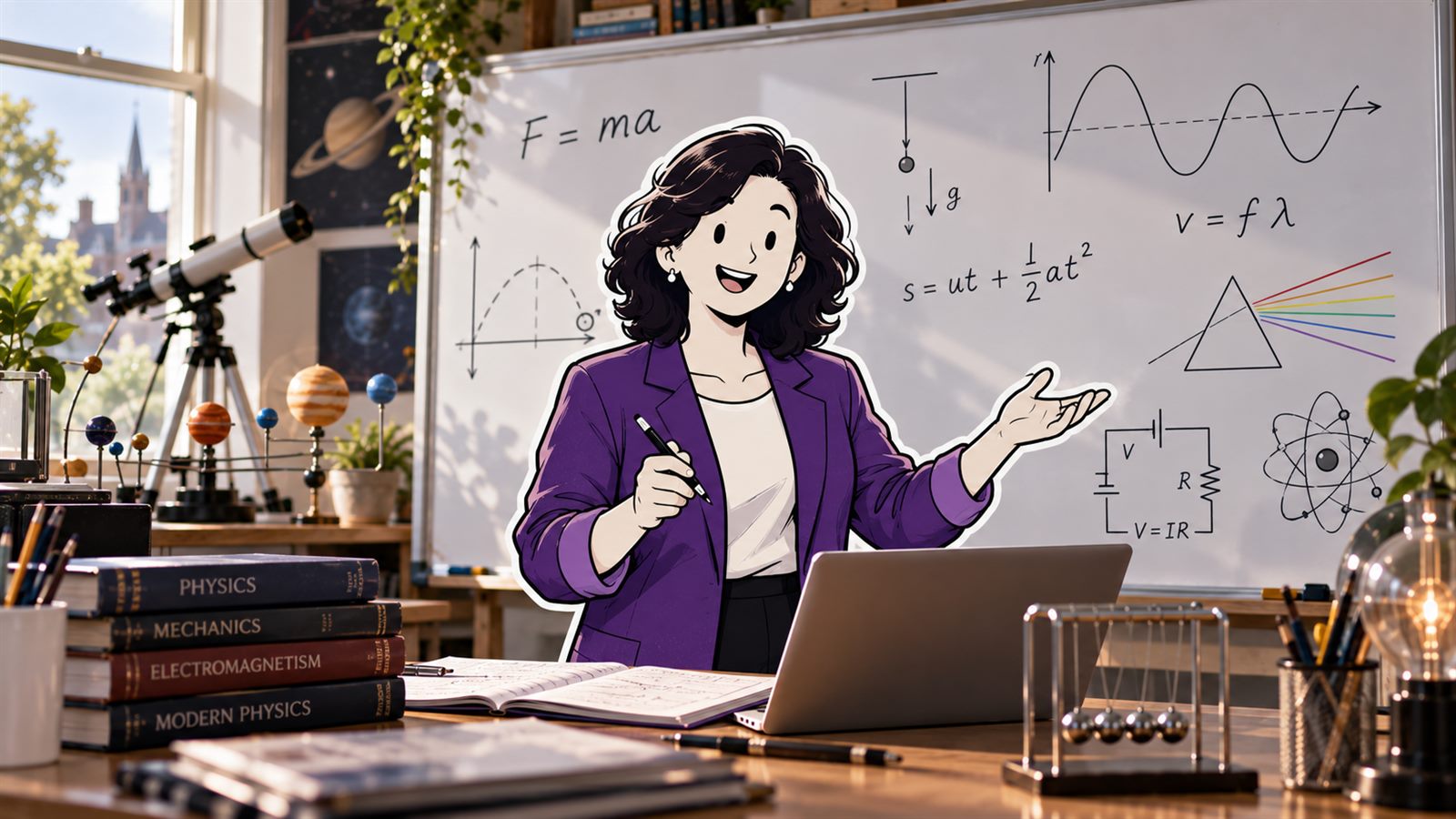
Richmond Tutoring provides 1-to-1 online A-Level Physics tutoring for students in Years 12 and 13 across the UK. With our physics tutors, your child will develop a deeper understanding of mechanics, electricity, waves, fields, particles and thermodynamics, on their own exam board. They will work on complex calculations, required practicals and exam questions, learning how to apply physics, show clear working and tackle unfamiliar problems with confidence. Send us a marked paper and start with a free 45-minute A-Level physics lesson, before deciding anything.
A Richmond A-Level physics tutor teaches Year 12 and 13 students 1-to-1 online on AQA 7408, Edexcel 9PH0, OCR Physics A (H556) or OCR Physics B: Advancing Physics (H557), with the maths, the required practicals and the skills behind the practical endorsement built into the lessons.
Subject
A Level Physics
Years
Years 12–13
Tuition
1-to-1 online
Students
UK students
Exam boards
Pearson Edexcel, AQA, OCR A, OCR B
Lesson length
60 minutes
Price
£36 per lesson
First lesson
Free 45-minute demo
Why us
Why Parents Choose Richmond for A Level Physics Tutoring
A-Level Physics rewards students who can see how the topics connect and who are fluent in the maths. That shapes how we teach it.
Mechanics made secure first
Resolving forces, the equations of motion, momentum and energy run under almost everything else: materials, circular motion, oscillations, even particles in a field. If Year 12 mechanics is shaky, later topics wobble with it, so that is where we check first, on your child’s own specification.
Fields taught as one idea
Gravitational and electric fields share the same structure: an inverse-square force, field strength, potential, and field strength as a potential gradient. We teach the parallels and the differences side by side, so a student who understands one has a head start on the other, and on magnetic flux and induction.
Maths and practicals in the same lesson
At least 40% of the marks use maths at a higher level than GCSE, and at least 15% assess practical skills. We use the required practicals to teach both at once: finding g from a gradient, plotting ln V against t for a discharging capacitor, combining percentage uncertainties.
When to get help
When Does a Student Need an A-Level Physics Tutor?
Usually when a strong GCSE student hits the maths of Year 12, or when the abstract Year 13 topics arrive. These are the sentences we hear from parents most often.
She got a 9 in GCSE physics and is suddenly on a D.
A grade 9 that has turned into a D
The first Year 12 topics look familiar — units, particles, waves, forces — so students revise lightly. Then questions stop asking for one equation and start needing two or three combined, with no structure given. We rebuild the method on those early topics before the first school assessment sets a low baseline.
He understands it in class but cannot do the calculations.
Rearranging, trigonometry and logs
Most lost marks are maths, not physics: rearranging with squares and roots, resolving a force at an angle, or using logarithms to turn exponential decay into a straight line. We teach each technique the first time the physics needs it, then practise it in that physics.
Fields and capacitors make no sense to her.
Year 13 fields, capacitors and induction
Gravitational, electric and magnetic fields, capacitor discharge and Faraday’s law are where many students stop being able to picture what is happening. We draw it first — field lines, equipotentials, flux linkage — and calculate second.
He loses marks on every practical question.
Uncertainties, error bars and the practicals
Practical questions ask for a percentage uncertainty, error bars, the gradient of a best-fit line and an improvement to the method. Each board’s required or core practicals come back year after year, so we work through every one as a written exam question.
She took Combined Science, not separate physics.
From Combined Science to Year 12
Combined Science students may have missed some Triple-only physics, such as space physics on AQA, and have had less practice at long calculations. A few focused lessons over the summer or in the first half-term usually close the gap before it shows in a test.
His predicted grade is below the offer he wants.
A prediction below the offer
Most schools base predictions on Year 12 exams and mocks, so the marks that matter for UCAS come well before the final papers. We work back from those dates and spend the time on the topics the mock will test.
She needs an A* for her engineering offer.
Pushing for an A*
At the top, marks go on synoptic questions that mix topics — energy in a fields question, momentum in a nuclear decay — and on precise explanations written under time. That calls for whole papers and the hardest questions, not more notes.
Who we teach
A Level Physics Tutoring by Exam Board
Four specifications, and they differ more than at GCSE: in how the content is split across papers, in how much multiple choice there is, and in what the last paper is for. Lessons use your child’s own board’s past papers, mark schemes and data booklet.
9PH0
Edexcel A-Level Physics Tutor
Edexcel A-Level Physics tutoring for specification 9PH0
An Edexcel A-Level physics tutor for 9PH0, where two shorter papers split the topics and a long third paper covers everything.
Paper 1Advanced Physics IPaper 2Advanced Physics IIPaper 3General and practical principles
3 papers · 1h 45m, 1h 45m and 2h 30m · 90, 90 and 120 marks
What your child is taught
On 9PH0, Advanced Physics I covers mechanics, electric circuits, further mechanics, electric and magnetic fields, and nuclear and particle physics. Advanced Physics II covers materials, waves and the particle nature of light, thermodynamics, space, nuclear radiation, gravitational fields and oscillations. Schools may teach it concept-led or through the Salters Horners context-led route; both sit the same papers.
This is the UK A-Level, not the International A-Level, and past papers for one do not fit the other.
Where we spend the time
General and Practical Principles is two and a half hours and 40% of the grade, and half of it tests practical skills built on the core practicals. We rehearse it whole, and keep the core practicals in view from Year 12.
7408
AQA A-Level Physics Tutor
AQA A-Level Physics tutoring for specification 7408
An AQA A-Level physics tutor for 7408, with three equal-length papers and an optional topic chosen by the school.
Paper 1Year 12 core and periodic motionPaper 2Thermal, fields and nuclearPaper 3Practical skills and your option
3 papers · 2 hours each · 85, 85 and 80 marks
What your child is taught
On 7408, Paper 1 covers measurements, particles and radiation, waves, mechanics and materials, electricity and periodic motion. Paper 2 covers thermal physics, fields and their consequences, and nuclear physics. Each has 60 marks of written questions and 25 multiple-choice questions. Paper 3 has 45 marks on practical skills and data analysis, then 35 marks on one option: Astrophysics, Medical physics, Engineering physics, Turning points in physics or Electronics.
The 12 AQA A-Level physics required practicals, from stationary waves on a string to the inverse-square law for gamma radiation, are examined across all three papers.
Where we spend the time
Paper 3 is the one students underestimate. The option is often taught late in Year 13, and the data-analysis section rewards practice rather than revision, so we start both early. We can teach any of the five options.
H556
OCR A-Level Physics Tutor
OCR Physics A tutoring for specification H556
An OCR A-Level physics tutor for Physics A (H556), the content-led OCR course taught in six modules.
Paper 1Modelling physicsPaper 2Exploring physicsPaper 3Unified physics
3 papers · 2h 15m, 2h 15m and 1h 30m · 100, 100 and 70 marks
What your child is taught
On H556, Modelling physics tests forces and motion plus the Newtonian world and astrophysics; Exploring physics tests electrons, waves and photons plus particles and medical physics. Both include the practical and foundation modules and open with 15 marks of multiple choice. Unified physics, 70 marks, draws on all six modules at once.
Check the code on your child’s mock paper: Physics A and Physics B are different A-Levels, and their past papers do not match.
Where we spend the time
Unified physics punishes revising one module at a time. We practise questions that cross them — capacitors with exponential decay, circular motion with gravitational fields — from Year 12 onwards.
H557
OCR Advancing Physics Tutor
OCR Physics B (Advancing Physics) tutoring for specification H557
An OCR Advancing Physics tutor for Physics B (H557), the context-led course with an advance notice article.
Paper 1Fundamentals of physicsPaper 2Scientific literacy in physicsPaper 3Practical skills in physics
3 papers · 2h 15m, 2h 15m and 1h 30m · 110, 100 and 60 marks
What your child is taught
H557 starts from applications — imaging, signals, materials, the “clockwork universe” of Newtonian mechanics — and builds the physics from there. All three papers draw on the whole course. Fundamentals of physics opens with 30 marks of multiple choice; Practical skills in physics, 60 marks, puts data analysis at the centre.
Questions tend to describe an unfamiliar situation and ask which physics applies, and the course leans on computational modelling for decay, capacitors and oscillations.
Where we spend the time
Scientific literacy in physics includes a section of about 25 marks set on an advance notice article sent to schools before the exam. We help your child understand the article and the physics in it — without claiming to predict the questions.
Results
Results: an Honest Note
A*our top published A-Level grade so far, in Maths
Our results page lists grades one student at a time, checked against the slip. Every entry so far is maths: the A* above and 11 GCSE grade 9s since 2024. There is no A-Level Physics grade on it yet.
When there is, it will appear in the same way. For now, the fairest test is a free lesson on a physics question your child got wrong.
Year 12 builds the toolkit: measurement, mechanics and electricity. Year 13 uses it on fields, thermal and nuclear physics, then tests the lot together.
A Level Physics Tutoring for Year 12
In Year 12 the content is broad and the habits are new: SI units and uncertainties on every answer, vectors resolved into components, and electrical circuits analysed with potential dividers and internal resistance rather than simple rules. Particles and quantum phenomena bring the first truly unfamiliar ideas.
We keep pace with school topic by topic, because the Year 12 exam is often what a predicted grade is built on.
Measurements, uncertainties and the first required practicals
Mechanics and materials: projectiles, momentum, stress, strain and the Young modulus
Electricity, waves and the photoelectric effect
A Level Physics Tutoring for Year 13
Year 13 is the more abstract year: circular motion and simple harmonic motion, ideal gases, gravitational and electric fields, capacitors, electromagnetic induction and nuclear physics, plus the AQA option for students on that board. It arrives alongside UCAS deadlines and mocks.
From spring, A-Level physics exam preparation takes over: timed papers on your child’s own specification, synoptic questions that reach back into Year 12, and each lost mark carried into the next lesson.
Fields, capacitors and induction, drawn before they are calculated
Exponential decay in capacitors and radioactivity, with logs
Whole past papers, marked against the board’s scheme
What the papers test
Physics, Maths and Practical Skills
The physics, the maths that expresses it, and the practical work that tests it are examined together, often in the same question. Here is what each involves at A-Level.
A-Level Physics Topics
The boards name and order them differently, but the core physics is shared:
Measurements and uncertainties
Particles and quantum phenomena
Waves and optics
Mechanics, momentum and materials
Electricity
Thermal physics and gases
Circular motion and SHM
Gravitational and electric fields
Capacitors
Magnetic fields and induction
Nuclear physics and radioactive decay
An option or applied topic, depending on the board
Maths for A-Level Physics
At least 40% of the marks test maths at a level above GCSE, applied to physics. The skills that cost most marks:
Rearranging and combining equations
Trigonometry and vectors
Exponentials and logarithms
Plotting ln y or y against x² to get a straight line
Gradients and areas under graphs
Significant figures, standard form and estimation
A-Level Physics Practical Skills
At least 15% of the written marks are on practical work. Separately, the school assesses the practical endorsement against the CPAC criteria. The focus is on:
Planning an experiment
Recording data properly
Plotting and lines of best fit
Percentage uncertainties
Evaluating a method
Exam questions on the required and core practicals
The bigger goal
A Level Physics for University Preparation
Physics, usually alongside A-Level Maths, is the standard route into degrees in physics and most kinds of engineering, and a common one into natural sciences. For those courses the physics grade is often named in the offer.
Some universities also make a Pass in the practical endorsement a condition. If your child has an offer, send us the exact terms and we will plan the remaining months around the grade it asks for.
Getting started
How to start?
We have kept this deliberately simple: you get to test your A-Level physics tutor on a real lesson before you decide anything.
1
Step one
Tell us about your child
Fill in the form or send us a WhatsApp message. We arrange the free demo class and match your child with a specialist A-Level physics tutor.
2
Step two
Take the demo class
Take the free 45-minute lesson, and sit in if you want to. See how the lesson goes, ask us everything you want to ask, and only go ahead with A-Level physics lessons if you are convinced.
3
Step three
Lessons begin
Lessons begin, weekly. Your child starts learning the A-Level physics they were stuck on, and that is what turns into marks on the three A-Level physics papers.
At Richmond Tutoring, the price for each 60-minute lesson of physics for A-Level is as follows:
£36per hour
No contract
No placement fee
First lesson free
Who teaches
Who teaches A-Level Physics at Richmond Tutoring
Every tutor teaches only the subject they specialise in, and works from your child’s own exam board. Before anyone teaches for us they have an interview and give us a demo lesson, and your child keeps the same tutor from week to week.
What should parents look for in an A-Level physics tutor?
Physics has some particular things worth checking, whoever you choose:
Experience of teaching A-Level Physics on your child’s board, including Paper 3 or its equivalent
Fluency in the maths: logs, trigonometry, exponentials and graph work
Knowing the required or core practicals well enough to teach the exam questions on them
Lessons built from past papers and the board’s mark schemes, not a textbook from start to finish
A clear way to see progress between school tests
Then ask for a trial lesson before paying anything. Whether your child gets on with a particular tutor is the one thing no website can tell you.
How much does an A-Level physics tutor cost?
Richmond Tutoring charges £36 for a 60-minute 1-to-1 A-Level physics lesson, online, on any board — the same as every other subject and level we teach. The first 45-minute lesson is free. There is no package to buy, no placement fee and no minimum term.
What are the AQA A-Level Physics required practicals?
AQA 7408 has 12: stationary waves on a string; interference, including Young’s slits; g by free fall; the Young modulus; resistivity of a wire; emf and internal resistance; simple harmonic motion; Boyle’s and Charles’s laws; charging and discharging capacitors; the force on a current-carrying wire; flux linkage with a search coil; and the inverse-square law for gamma radiation. Questions on them can appear on any of the three papers, and Paper 3 Section A is built around practical skills and data analysis.
Is A-Level physics much harder than GCSE?
Yes, for most students. At GCSE a calculation is usually one equation from the sheet; at A-Level it is often two or three linked together, with the student deciding the route. The ideas also get more abstract, from wave–particle duality to fields. That is why the first term of Year 12 is when most families contact us.
Does my child need A-Level maths to take A-Level physics?
Not always — each school or college sets its own entry requirements. It helps a great deal, because at least 40% of A-Level physics marks use maths, including logarithms and trigonometry. Students without it, or who meet a technique in physics before maths reaches it, can be taught it in the physics context. If the gaps are wider, A-Level maths tutoring can run alongside.
Can my child do A-Level physics after Combined Science?
Usually yes, if they meet the school’s entry grades. They may have missed some Triple-only physics and will have done fewer long calculations. The summer before Year 12 is the best time to close that gap; our GCSE physics page shows the Triple content they may not have met.
What is the practical endorsement, and can a tutor help with CPAC?
The practical endorsement is a separate Pass or Not Classified reported alongside the A-Level grade. Teachers assess it in school against the Common Practical Assessment Criteria (CPAC), shared by all boards, over at least 12 practical activities. A tutor cannot award or complete it, and we never write up practical work. What we can help with is the skill behind it: planning, recording, graphs and uncertainties, which also earns marks in the written papers.
Can you tutor the AQA A-Level physics Paper 3 options?
Yes, all five: Astrophysics, Medical physics, Engineering physics, Turning points in physics and Electronics. The option is Section B of Paper 3, worth 35 marks, and most schools pick one for the whole class, so check which your child is taking. Section A, 45 marks on practical skills and data analysis, is prepared alongside it.
What is the difference between OCR Physics A and OCR Physics B?
They are two different A-Levels. OCR Physics A (H556) is content-led and teaches physics topic by topic. OCR Physics B: Advancing Physics (H557) is context-led and teaches physics through real applications, with an advance notice article sent out before the Scientific literacy paper. Past papers for one do not match the other, so check the code on a mock paper.
Can you help students retaking A-Level physics?
Yes. A-Level physics is linear, so a student retaking usually sits every paper again, not just the one that went badly. We start from the previous results and feedback, work on the papers and topics that lost the most marks, then move to full timed papers.
Is A-Level physics tuition available near me?
Yes. Every lesson is online and 1-to-1, so A-Level physics tuition is available wherever you are in the UK — there is no travel and nothing depends on how far you live from us.
Most of our families are in and around Twickenham, Richmond upon Thames and south-west London, including Teddington and Kingston, and we teach students across the UK. Every lesson is online and 1-to-1, so where you live makes no difference.
Start with a free A-Level physics demo class
A real 45-minute lesson, one to one, with a specialist A-Level physics tutor — free, before you decide anything. Tell us the year group and the exam board, and we will tell you honestly whether we can help.