Free demo class

KS3 Science Tutor | 1-to-1 Online Science Tuition for Years 7–9

Richmond Tutoring provides 1-to-1 online KS3 science tutoring for students in Years 7, 8 and 9 across the UK. Lessons follow your child’s own school scheme of work and cover biology, chemistry and physics, along with the practical skills GCSE goes on to examine. Every lesson is taught by a specialist science teacher. Tell us which science is going worst and the first 45-minute lesson is free.

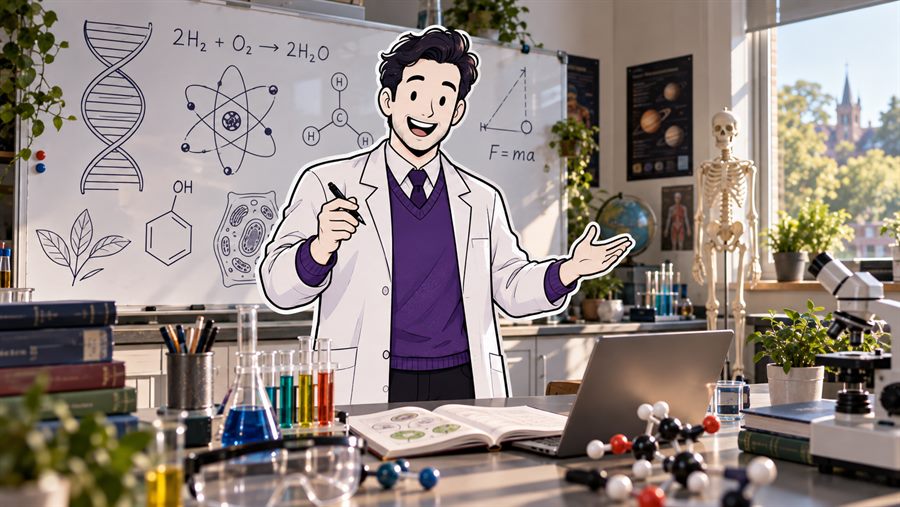
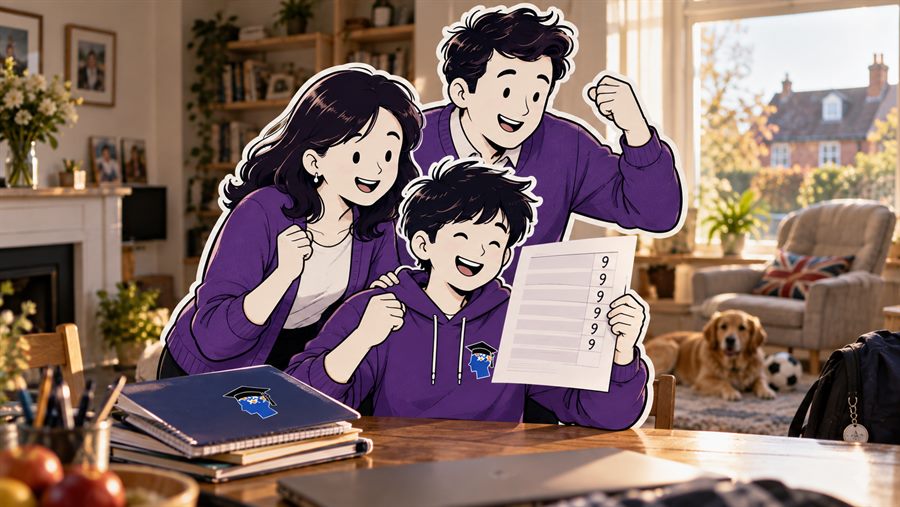
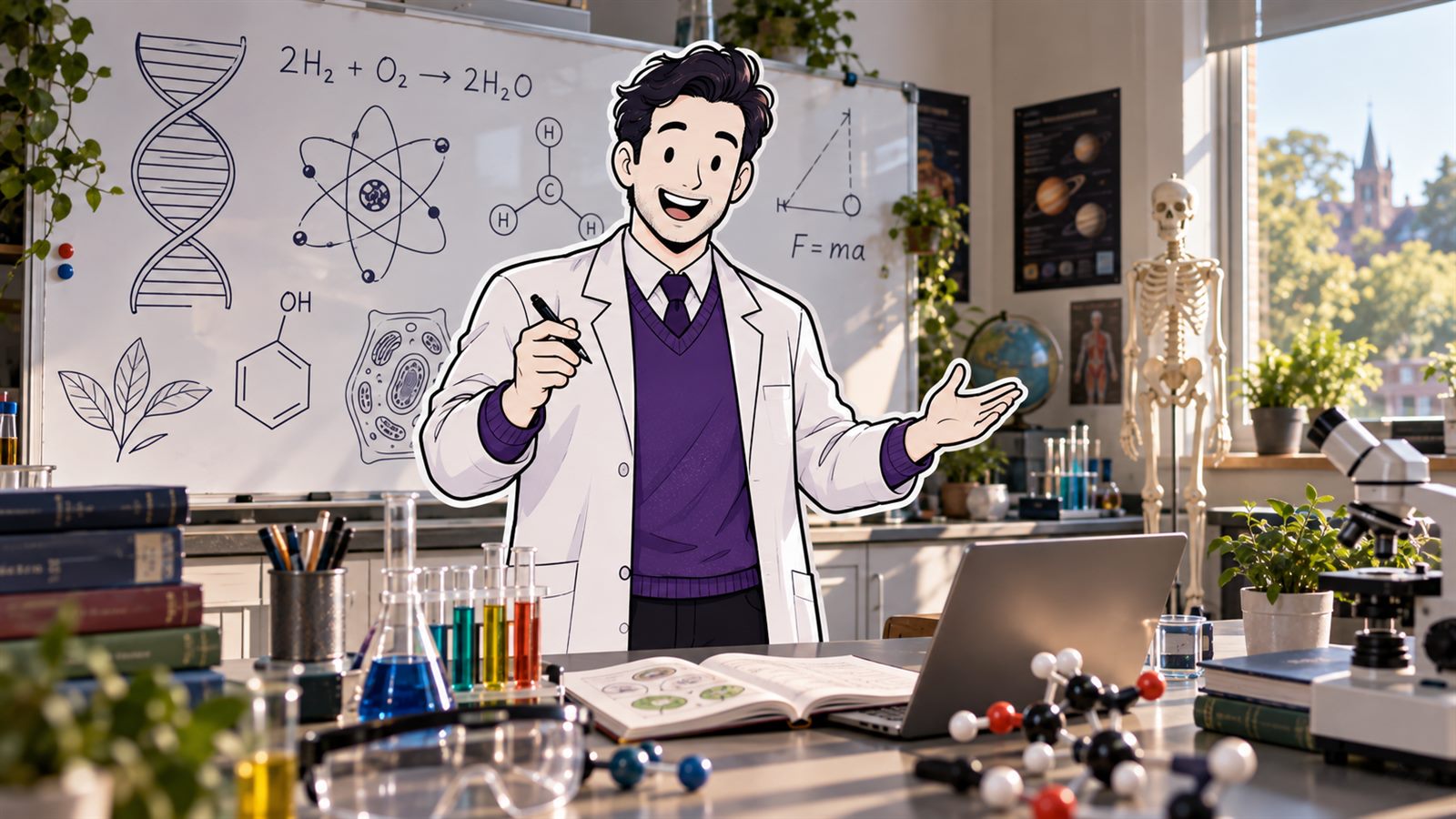
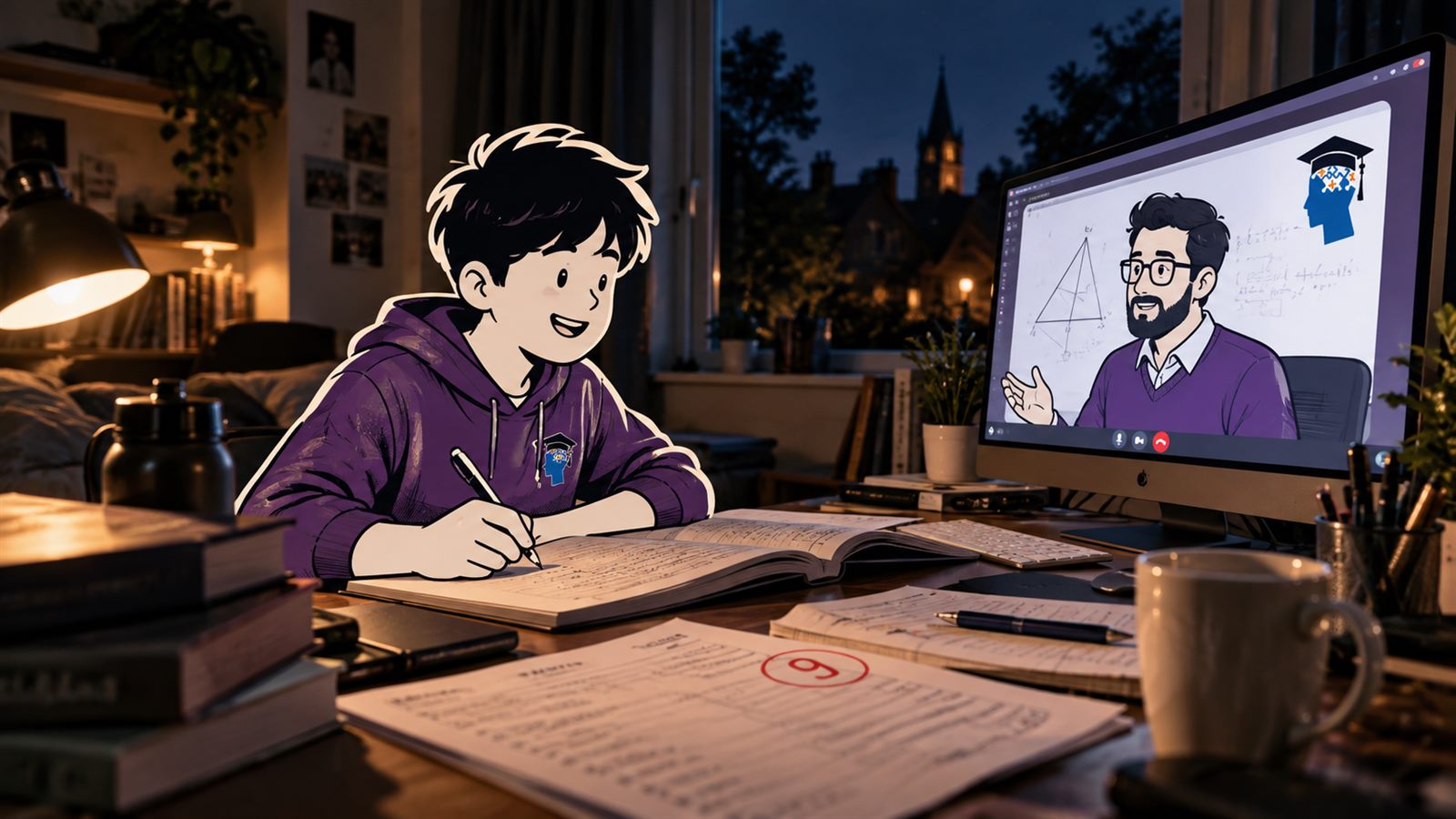
A science tutor at a whiteboard showing a DNA helix and a balanced chemical equation, with a lab bench of test tubes and molecular models alongside. A Year 8 student at his desk at home in a one-to-one online science lesson, his tutor on screen. A family at the kitchen table reading a school report together.
The short answer

KS3 Science Tutoring at a Glance

Richmond Tutoring offers 1-to-1 online KS3 science tutoring for Years 7–9 across the UK, following your child’s own school scheme of work across biology, chemistry and physics.

Subject
KS3 Science
Years
Years 7–9
Tuition
1-to-1 online
Students
UK students
Curriculum
Your child’s school curriculum
Lesson length
60 minutes
Price
£36 per lesson
First lesson
Free 45-minute demo
Why us

Why Parents Choose Richmond for KS3 Science Tutoring

Every child starts somewhere different. We build the tutoring around their gaps, their school and their pace.

A science plan built around your child

KS3 Science covers biology, chemistry and physics, and children often develop at very different speeds across the three. We find the gaps first — whether it is cells, particles, forces or energy — then build lessons around what your child is learning at school and where they need more support.

We make science easier to understand

At this age, science starts moving beyond simple facts. Your child needs to understand what is happening and explain why. We use clear examples, diagrams and questions to make topics such as chemical reactions, forces, electricity and ecosystems easier to picture and understand — rather than asking them to memorise pages of notes.

The learning shows up in their schoolwork

Your child should be able to use what they have learnt when the next science test comes around. We practise scientific vocabulary, calculations, graphs, practical questions and explaining ideas clearly — building the skills that improve KS3 performance and give them a stronger start at GCSE.

Where we come in

What Does a KS3 Science Tutor Help With?

Every child has a different experience of KS3 Science. These are some of the concerns we hear from parents most often.

She was fine at primary science and now she is lost.

The jump to secondary science

Year 7 brings a lab, three specialist teachers and language that has to be exact. A child who was quick at primary science stalls the first time an answer has to be justified rather than stated. We rebuild whatever is shaky and teach the habit of explaining in full.

He is fine at biology but chemistry makes no sense.

One science weaker than the others

The most common thing parents tell us, and worth acting on now: at GCSE the three are graded together in Combined Science, so the weakest one sets the ceiling. We lift the science that is behind without letting the other two drift.

His answers are too short and keep losing marks.

Written explanations

Science marks are given for the reason, not the fact. “It gets bigger” earns nothing where the scheme wants “the particles gain energy and move further apart”. We practise the longer answer every week, with the words mark schemes reward.

She panics whenever there is a calculation.

The maths inside science

Units, rearranging speed or density, means and anomalies, choosing a scale and drawing a line of best fit. It catches out more KS3 students than the science does. We teach it inside science questions, so it is obvious why it matters.

The report says he is behind, but there is no exam to show me why.

School assessments and sets

KS3 has no national exam, so a gap can hide behind a good effort grade for a year. Schools use their own tests for sets and, in many schools, for Triple Science. We work on what those tests actually assess and tell you what we see.

She wants to do Triple Science.

Getting ready for the Triple decision

Most schools decide in Year 9, from sets and from Year 8 and 9 assessments. Tutoring lifts the work those decisions rest on, and gives a student an honest feel for the harder topics before committing to three GCSEs.

Year by year

KS3 Science Tutors for Years 7, 8 and 9

Year 7, Year 8 and Year 9 are three different jobs. What a tutor works on changes with each one.

Year 7 Science Tutoring

Year 7 is a change of pace, not just a change of content.

Year 7 science tutoring settles the basics that everything later rests on: the particle model, cells and the microscope, forces and energy, and the habit of writing an answer in full sentences with the right words in them.

We start the measuring habits early too — units, reading a scale, recording results properly — because they are marked for the next five years.

  • The step up from primary science
  • The particle model, cells, forces and energy
  • Writing a full answer rather than a short one

Year 8 Science Tutoring

Year 8 is where gaps widen quietly, because nothing exposes them.

The content turns abstract — atoms and elements, electricity, photosynthesis and respiration — and a report can say “good effort” while the understanding underneath is thinning.

A Year 8 science tutor fixes the specific topics that are not sticking and introduces the first real calculations: speed, density and energy, with confident rearranging.

  • Atoms, elements and the periodic table
  • Electricity, photosynthesis and respiration
  • Speed, density and energy calculations

Year 9 Science Tutoring

Year 9 is the bridge, and at many schools it is already GCSE.

Expectations rise: longer answers, more maths, and practical questions that look a lot like GCSE ones. It is also the year most students choose between Combined and Triple Science.

Year 9 science tutoring closes what is left of KS3 before it becomes a GCSE gap, and strengthens the topics GCSE builds on hardest.

  • The KS3 topics GCSE builds on most directly
  • Longer written answers and practical questions
  • The Combined or Triple decision, made on evidence
Results speak

KS3 Science Tuition That Delivers Measurable Progress

22%average improvement in assessment scores

KS3 has no national exam, so we measure progress against your child’s own school assessments and the work we mark in lessons — where a student started with us, against where they are now. It is an average across our KS3 science students.

A family at the kitchen table reading a school report together.
The subject

What Does the KS3 Science Curriculum Cover?

Key Stage 3 is the first three years of secondary school in England — Years 7, 8 and 9, typically ages 11 to 14. Biology, chemistry and physics are taught together, alongside the practical skills that run through all three.

In England, KS3 science follows the national curriculum rather than a GCSE exam-board specification. It is statutory in maintained schools; academies and free schools set their own curriculum, and most follow it closely. Schools decide the order and the depth, so two children in the same year can meet the same topics eighteen months apart.

That is why we ask what your child is covering in class right now, and plan around it. Lessons support the schoolwork rather than running a separate syllabus alongside it.

There is no national end-of-KS3 science exam. Schools use their own tests and reports to track progress, and those results often decide science sets and, at many schools, who is offered Triple Science later.

For students elsewhere in the UK, lessons follow their school’s curriculum and year group in the same way.

The KS3 science curriculum covers:

  • Biology: cells and organisation, skeleton and muscles, nutrition and digestion, gas exchange, reproduction, health, photosynthesis, respiration, ecosystems, inheritance and evolution
  • Chemistry: the particle model, atoms, elements and compounds, pure and impure substances, chemical reactions, energy changes, the periodic table, materials, Earth and atmosphere
  • Physics: energy, motion and forces, pressure in fluids, waves, sound and light, electricity and magnetism, matter and the particle model, space
  • Working Scientifically: planning investigations, variables, measurement and units, recording and presenting data, analysing results, evaluating evidence, scientific attitudes
How it works

How Our KS3 Science Tutoring Works

Three steps, and you meet the tutor in a real lesson before deciding anything.

  1. 1
    Two parents at the kitchen table on a video call, a phone propped up in front of them.
    Step one

    Tell us about your child

    Fill in the form or send us a WhatsApp message. We arrange the free demo class and match your child with a specialist KS3 science tutor.

  2. 2
    A science tutor at a whiteboard of chemical equations and diagrams, a lab bench in front.
    Step two

    Take the demo class

    Take the free 45-minute lesson, and sit in if you want to. See how the lesson goes, ask us everything you want to ask, and only go ahead with KS3 science lessons if you are convinced.

  3. 3
    A family at the dining table looking pleased with a school report.
    Step three

    Lessons begin

    Lessons begin, weekly. Your child starts learning the KS3 science they were stuck on, and that shows up in their class work and their school tests.

Cost

What Will KS3 Science Tuition Cost?

At Richmond Tutoring, the price for each 60-minute lesson of science for KS3 is as follows:

£36per hour

  • No contract
  • No placement fee
  • First lesson free
Questions

FAQs

What is KS3 science?

KS3 science is the science taught in the first three years of secondary school — Years 7, 8 and 9. In England it follows the national curriculum rather than an exam-board specification, and it covers biology, chemistry and physics together with working scientifically, the practical and investigative skills used across all three.

Is there an exam at the end of KS3 science?

No. There is no national KS3 science exam. Schools assess progress with their own tests and reports, and those results often decide science sets and who is offered Triple Science at GCSE, so they still matter.

Does KS3 science have an exam board?

No. In England, KS3 follows the national curriculum and each school builds its own scheme of work from it, so the order topics are taught in differs from school to school. That is why we ask what your child is covering in class right now. If their school has already started GCSE content in Year 9, lessons follow that course and exam board instead.

Can one tutor cover biology, chemistry and physics?

Yes. KS3 science is taught as a single subject in most schools, and lessons move between the three according to what your child is studying and where the marks are being lost. Most students are noticeably weaker in one of the three, and finding out which is the first job.

How much does a KS3 science tutor cost?

£36 for a 60-minute 1-to-1 lesson, the same as every other subject and level we teach. There is no placement fee and no contract — you pay per lesson and can pause whenever you like. The first 45-minute lesson is free.

Will KS3 tutoring help my child get into Triple Science?

It can help, but nobody can promise a place. Schools decide how Triple Science is allocated, usually from sets and from Year 8 and Year 9 assessments. Tutoring strengthens the knowledge and the practical skills those assessments test, and it gives a student an honest sense of whether they will cope with the pace if they are offered it.

Is Year 7 too early for a science tutor?

Usually, yes — most Year 7 students do not need weekly lessons. It is worth it when a child arrived from primary already behind, or when the change to specialist teaching and lab work has knocked their confidence. A short run of lessons on the topics that are not landing is often enough, and we will say so after the free demo class.

My child is fine in science but weak in maths. Which should we start with?

Often maths, because weak maths quietly holds science back as well. Units, rearranging a formula, reading a scale and drawing a line of best fit all turn up in KS3 science, and at GCSE maths skills are worth at least 10% of the marks in biology, 20% in chemistry and 30% in physics. At the free demo class we look at where the marks are actually going and say which subject to start with. KS3 maths tutoring runs on the same format.

How often should a KS3 student have science lessons?

Once a week suits most students. It keeps pace with school and leaves room for the practice in between without science taking over the week. For one specific gap, or an assessment coming up, a shorter focused run works just as well, and you can stop at any time.

Is KS3 science tutoring available near me?

Yes. Every lesson is online and 1-to-1, so KS3 science tutoring is available wherever you are in the UK — there is no travel and nothing depends on how far you live from us.

Most of the families we teach are in and around south-west London, and we also teach students across the rest of the UK. Places our students come from include Brentford, Turnham Green, Parsons Green, Surbiton, Hampton Wick, Osterley, Grove Park, Fulham, Kingston upon Thames, Hampton Hill, Hounslow West, Kew, Barons Court, Barnes, Hampton, Hounslow, Kew Bridge, Ravenscourt Park, East Sheen, Teddington, Isleworth, Gunnersbury, Hammersmith, North Sheen, Whitton, Heathfield, Chiswick, Ealing Common, Mortlake, Strawberry Hill, Fulwell, Ashford, Ealing, Petersham, St Margarets, North Twickenham, Sunbury, South Acton, Ham, Twickenham, West Twickenham, Feltham, Acton, West Kensington, Wimbledon, East Twickenham, Hanworth, Bedford Park, Brook Green, Tolworth, Richmond Hill, Syon, Stamford Brook, Shepherd’s Bush, Hampton Court, Richmond.
Book a free 45-minute KS3 science demo class

A real lesson, one to one, with a specialist KS3 science tutor — free, before you decide anything. Tell us the year group and which science is going worst, and we will tell you honestly whether we can help.

  • No placement fee, no contract, nothing to sign
  • We reply to every enquiry the same day

Ask for the demo class

Five boxes, and we have filled two of them in for you.

We only use your details to answer this enquiry. Privacy · Terms

Thank you — that’s with us.

We’ll be in touch to arrange the demo class, usually the same day. If it’s urgent, ring 07901 286606.

Free 45-minute demo class. Tell us the year group and the exam board.

07901 286606 Book a free demo class