Most Year 7 students sit a CAT4 test in their first weeks at secondary school, and the results often arrive home in the autumn term with a page of numbers and very little explanation. This guide explains what CAT4 measures, how to read the scores, how schools use them for maths sets and targets, and what to do if the results (or the set) don't match the child you know.
The short answer: CAT4 is a reasoning test, not a maths or English exam. It gives a score for verbal, quantitative (number), non-verbal and spatial reasoning, where 100 is average for your child's age and about two thirds of children score between 85 and 115. Schools use it, often alongside Year 6 SATs, to set targets and to place students in sets. A CAT4 score shows potential, not what your child has learned, so a low maths set or a gap between the CAT4 score and classwork is a reason to look at the maths itself, not a final verdict.
What is the CAT4 test?
CAT4 (the Cognitive Abilities Test, fourth edition) is made by GL Assessment and used by many secondary schools in the UK. GL describes it as a test of how students think "in areas that are known to make a difference to learning". It does not test the school curriculum.
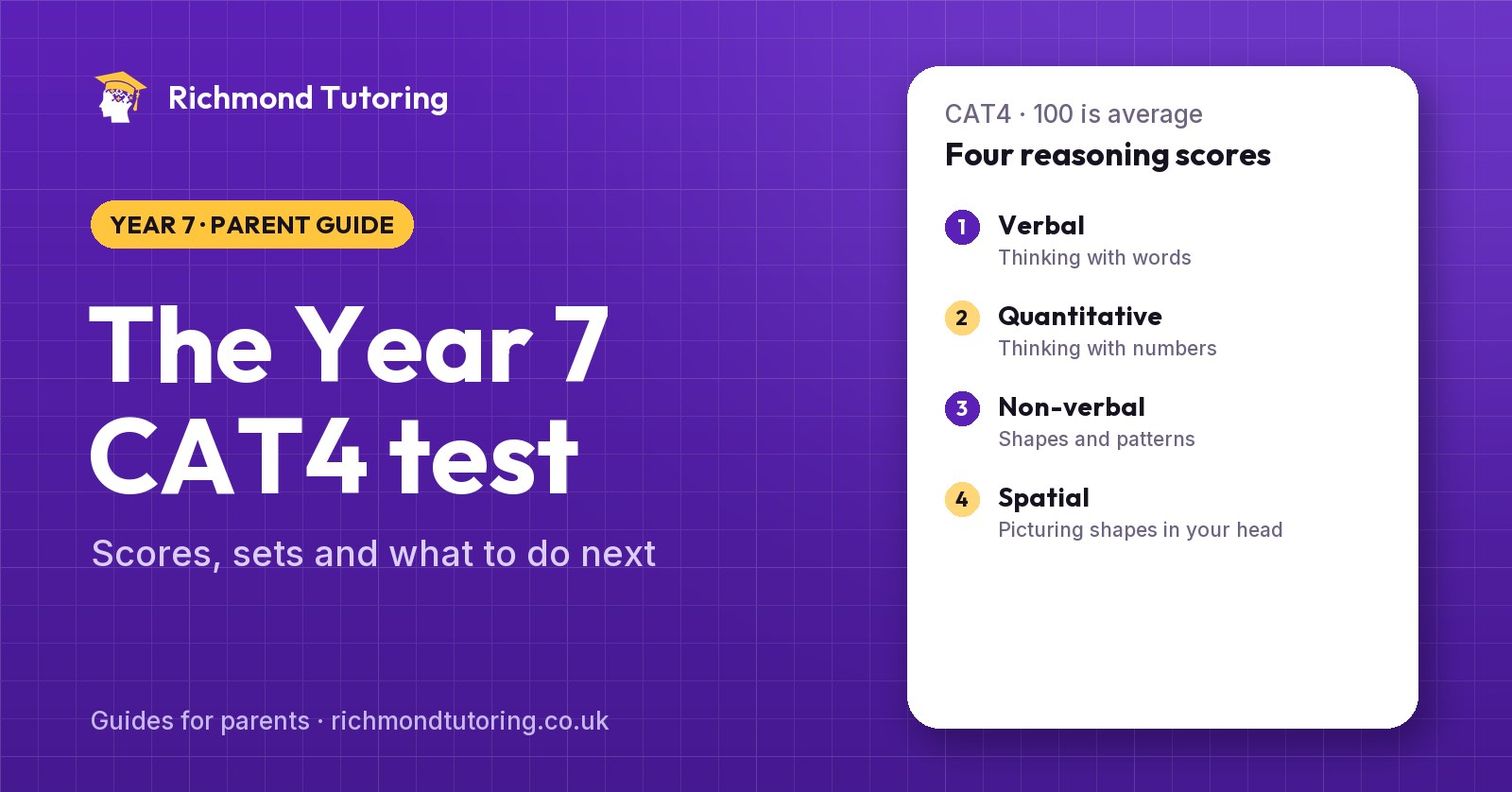
There are four parts, called batteries:
| Battery | What it tests | Why it matters in school |
|---|---|---|
| Verbal reasoning | Thinking with words: word meanings, links and patterns | Reading-heavy subjects such as English, history and RE |
| Quantitative reasoning | Thinking with numbers: number patterns and relationships | Maths and the number side of science |
| Non-verbal reasoning | Shapes and patterns, without words or numbers | Problem solving in general, including maths and science |
| Spatial ability | Picturing shapes and moving them in your head | Geometry, design and technology, physics, art |
The test is taken on screen or on paper under timed, formal conditions. Each section starts with practice examples that aren't timed.
When do students take CAT4?
Most schools use it at the start of Year 7, in September or October, because it gives teachers a fair picture of every new student whatever their primary school. Some schools test again in Year 9 before GCSE options, and some use it for admissions or scholarships.
Should your child practise for it? No. GL strongly advises against practice, because it makes the scores less reliable. GL compares it to an eye test: learning the chart by heart gives the wrong prescription. A good night's sleep and a calm morning are the only preparation worth doing.
How to read CAT4 scores
Schools don't all share the full report with parents, but if you have it you will see some or all of these numbers for each battery.
Standard age score (SAS). This is the main score. It compares your child with a national sample of children of the same age, to the month, and 100 is average. About two thirds of children score between 85 and 115.
Stanine. A simpler 1 to 9 scale, where 5 is the middle. GL's bands are:
| Stanine | Description | Standard age score | Share of children |
|---|---|---|---|
| 9 | Very high | 127 and above | 4% |
| 7–8 | Above average | 112 to 126 | 19% |
| 4–6 | Average | 89 to 111 | 54% |
| 2–3 | Below average | 74 to 88 | 19% |
| 1 | Very low | 73 and below | 4% |
National percentile rank (NPR). The percentage of children of the same age who scored the same or lower. An NPR of 50 is average; an NPR of 80 means your child scored as well as or better than 80% of children their age.
Mean SAS. The average of the four battery scores. It's a useful single number, but the four separate scores tell you more.
The profile: which way your child leans
The report also shows whether your child's scores are balanced or tilted. A student with a much higher verbal than spatial score may prefer to learn through words and explanation; a student with a stronger spatial score may get on better with diagrams, models and visual methods. Neither is better. It's information for teachers about how to teach.
GCSE indicators
Many schools also receive GCSE indicators from CAT4: for each subject, the grade a student with similar scores most often goes on to get, and usually a higher "if challenged" grade. These are statistics about groups of students, not a prediction for your child. They can't see effort, teaching, or a gap that gets fixed in Year 8. Treat a GCSE indicator from Year 7 as a starting point, never a ceiling.
How schools use CAT4 for maths sets
Most secondary schools set for maths, often from Year 7 or soon after. The first sets are usually based on some mix of:
- Year 6 SATs. The maths test gives a scaled score from 80 to 120, where 100 means the expected standard.
- CAT4, especially the quantitative and non-verbal scores.
- The school's own baseline test in the first few weeks.
- Information from the primary school.
Each school weights these differently, so ask. Sets are normally reviewed during the year, often after each round of assessments, and moving up is common for students whose classwork and tests are strong.
Why do maths sets matter?
In Years 7 and 8, sets mostly change the pace. By Year 9 and 10 they start to matter more, because the set often decides the GCSE tier: higher sets are usually entered for Higher (grades 4 to 9) and lower sets for Foundation (grades 1 to 5). Our guide to Foundation or Higher GCSE Maths explains why that decision matters. A student who drifts down the sets in Years 7 to 9 can end up on Foundation without anyone deciding that on purpose.
When CAT4 and maths don't match
Comparing the quantitative score with how your child is doing in maths class tells you a lot.
| What you see | What it often means | What to do |
|---|---|---|
| High quantitative score, low maths set or test results | The ability is there, but gaps from primary school (often fractions, times tables or written methods) are holding them back | Find the specific gaps and fix them. This is the most fixable situation of all |
| Average scores, top set | Strong teaching and hard work. Your child is doing well | Keep the habits going; watch for signs they are finding the pace hard |
| Low quantitative score, struggling in maths | Maths is genuinely harder for them, so it needs more practice, not less | Ask the school what support is available; short regular practice beats long sessions |
| Spatial much lower than other scores | Geometry, graphs and diagrams may feel harder than number work | Practise drawing diagrams; use physical models and visual methods |
A few things are worth knowing whatever the scores say:
- One test on one morning is one data point. A nervous 11-year-old in their third week at a new school may not show their best. Schools know this, and a good school looks at classwork too.
- CAT4 doesn't measure knowledge. A child can have a strong reasoning score and still have holes in the maths they were taught at primary school. Those holes are what lower set placements and test results usually come from, and they can be filled.
- Scores change. Reasoning develops through secondary school, especially with good teaching and plenty of reading.
Want a second opinion? Book a free 45-minute demo class with a specialist tutor — no contract, and an honest view of what your child needs.
Book a free demo classQuestions to ask at the Year 7 parents' evening
- Which sets is my child in, and what was that based on: SATs, CAT4, your own tests, or all three?
- When are sets reviewed, and what would my child need to show to move up?
- Are there any particular topics in maths where my child is behind?
- Does the CAT4 profile suggest anything about how my child learns best?
- Is there anything we can do at home that would help?
How to help at home in Year 7
- Times tables and number facts. Quick recall makes everything in Year 7 maths easier. Ten minutes a few times a week is enough.
- Fractions, decimals and percentages. These cause more Year 7 problems than anything else, and they come back in almost every GCSE topic. Our guide to what children learn in Year 7, 8 and 9 maths shows when each topic usually comes up.
- Reading. Verbal reasoning grows with reading, and word problems in maths depend on it.
- Talk about mistakes, not marks. Ask what went wrong on a test, not just what the score was.
Want a second opinion on where your child stands?
- The free KS3 Maths check takes about 25 minutes and shows which year's maths is secure and which topics need work, so you can see whether the set matches what your child actually knows.
- A free 45-minute demo class with a KS3 maths tutor, who will start from the gaps rather than the score. We also teach KS3 science.
The bottom line
CAT4 measures reasoning, not maths knowledge, and a score of 100 is exactly average. Schools use it with SATs and their own tests to set targets and maths sets, and sets begin to shape the GCSE tier by Year 9. If the scores and the set don't match the child you know, look at the specific maths topics behind the results. Gaps from primary school are common, and Year 7 is the easiest time to close them.