If your child's school has asked whether they should sit Foundation or Higher GCSE Maths, or you have just found out which tier they are down for, this guide explains what the choice really means. It covers the grades each tier allows, how many marks a grade 4 or 5 actually took in the June 2026 exams, and how to tell which tier gives your child the best result.
The short answer: Foundation tier leads to grades 1 to 5; Higher tier leads to grades 4 to 9. A child who is reliably working at grade 5 or above — or who needs a 6 or 7 for sixth form — should sit Higher. A child working at grade 3 or 4 is usually safer on Foundation, where a secure 4 or 5 is within reach. The hardest calls are for students on the 4/5 borderline, and for them mock results on both tiers are the best guide.
This guide covers GCSE Maths in England with AQA, Pearson Edexcel and OCR.
Foundation vs Higher at a glance
| Foundation tier | Higher tier | |
|---|---|---|
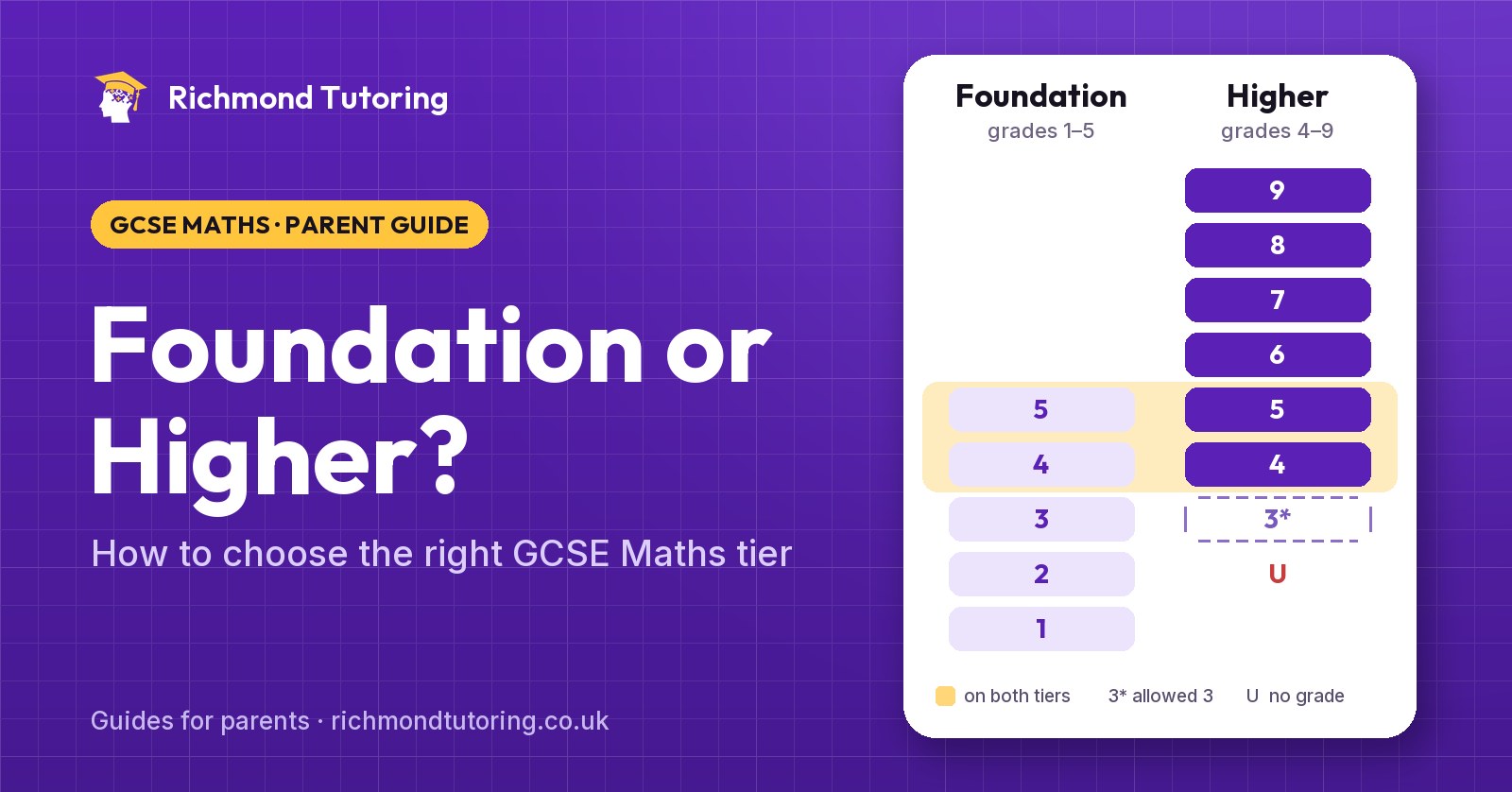
| Grades available | 1, 2, 3, 4, 5 | 4, 5, 6, 7, 8, 9 (plus an "allowed" 3) |
| Best possible grade | 5 | 9 |
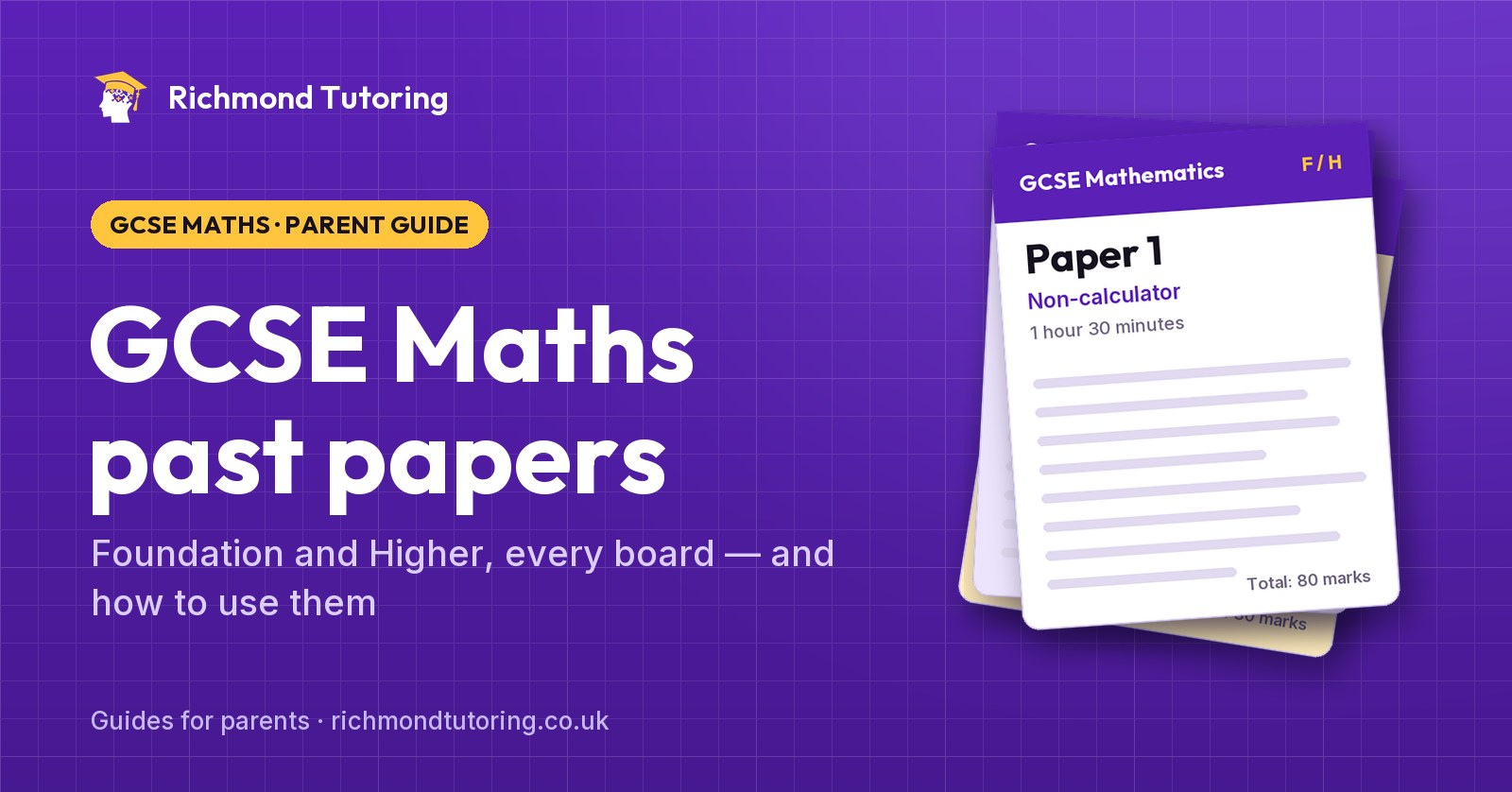
| Papers | 3 papers, 1 hour 30 minutes each | 3 papers, 1 hour 30 minutes each |
| Calculator | 1 non-calculator paper, 2 calculator | 1 non-calculator paper, 2 calculator |
| Content | The core GCSE content | Everything on Foundation, plus harder topics |
| Style of questions | More routine, single-step questions | More multi-step problems and reasoning |
| Needed for A-Level Maths | No — it cannot give the grade sixth forms ask for | Yes |
The papers are the same length on both tiers. AQA and Pearson Edexcel papers are out of 80 marks each (240 in total); OCR papers are out of 100 (300 in total). What changes is how hard the questions are, and which grades are available.
The grades each tier allows — and the risk on Higher
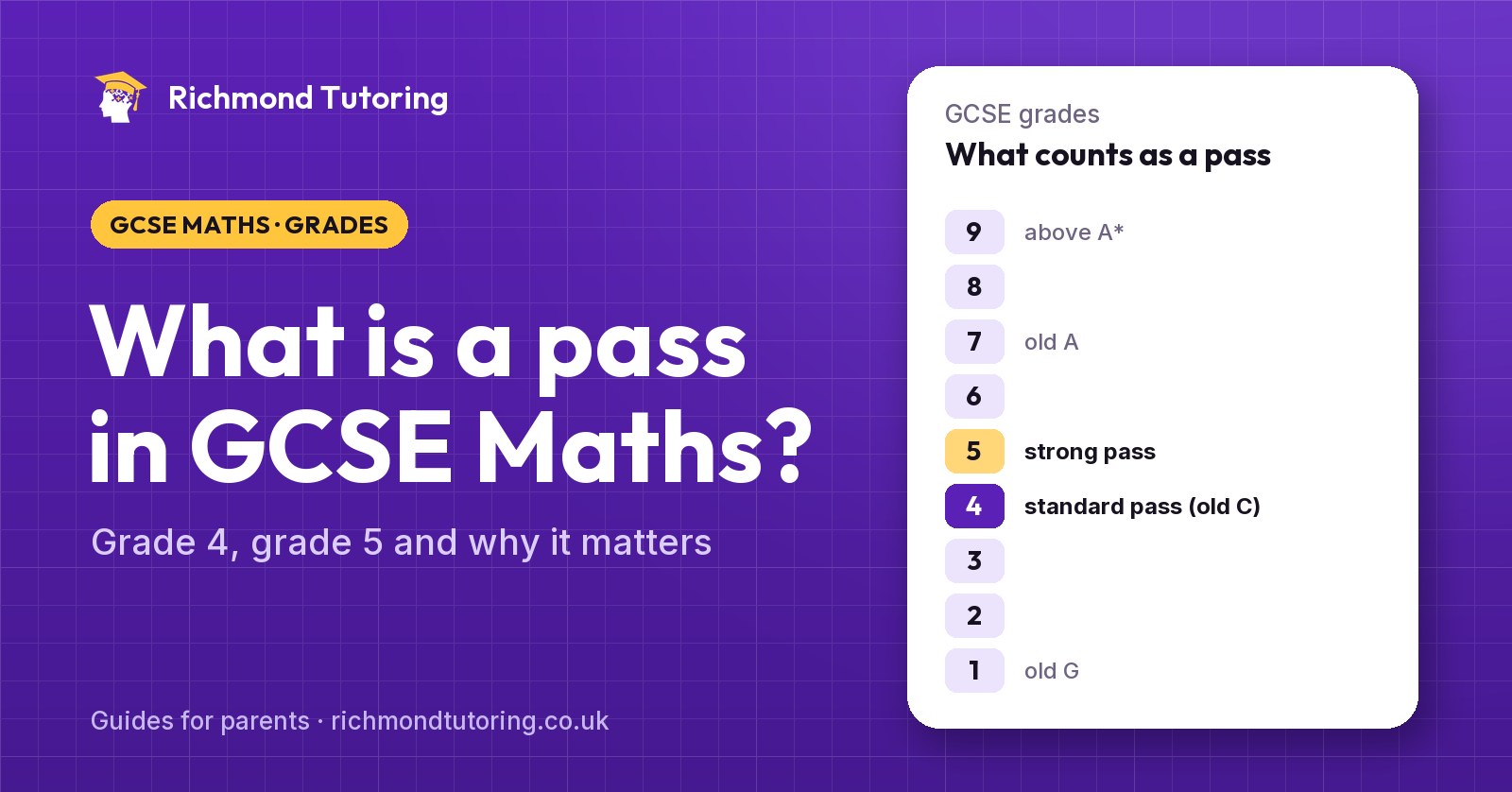
Foundation is graded 1 to 5. However well your child does, a Foundation paper cannot give more than a grade 5. Grade 4 is the "standard pass" and grade 5 the "strong pass", so Foundation still gives a full pass.
Higher is graded 9 to 4, with one safety net. A student who narrowly misses grade 4 can be awarded an "allowed" grade 3. Below that, there is no grade at all — the result is a U (unclassified). This is the real risk of Higher tier: a student who struggles with the papers can come away with nothing, where on Foundation the same student would probably have earned a 3 or a 4.
What counts as a pass on each tier
A grade 4 is a "standard pass" and a grade 5 is a "strong pass", on either tier. Grade 4 is the line that matters most: without it, students in England carry on studying maths after 16.
- On Foundation, a pass means reaching grade 4 or 5 — the top two grades on the paper.
- On Higher, grade 4 is the lowest full grade available. There is no grade 1 or 2 to fall back on, only the allowed 3 and then a U.
How many marks does a grade 4 or 5 take?
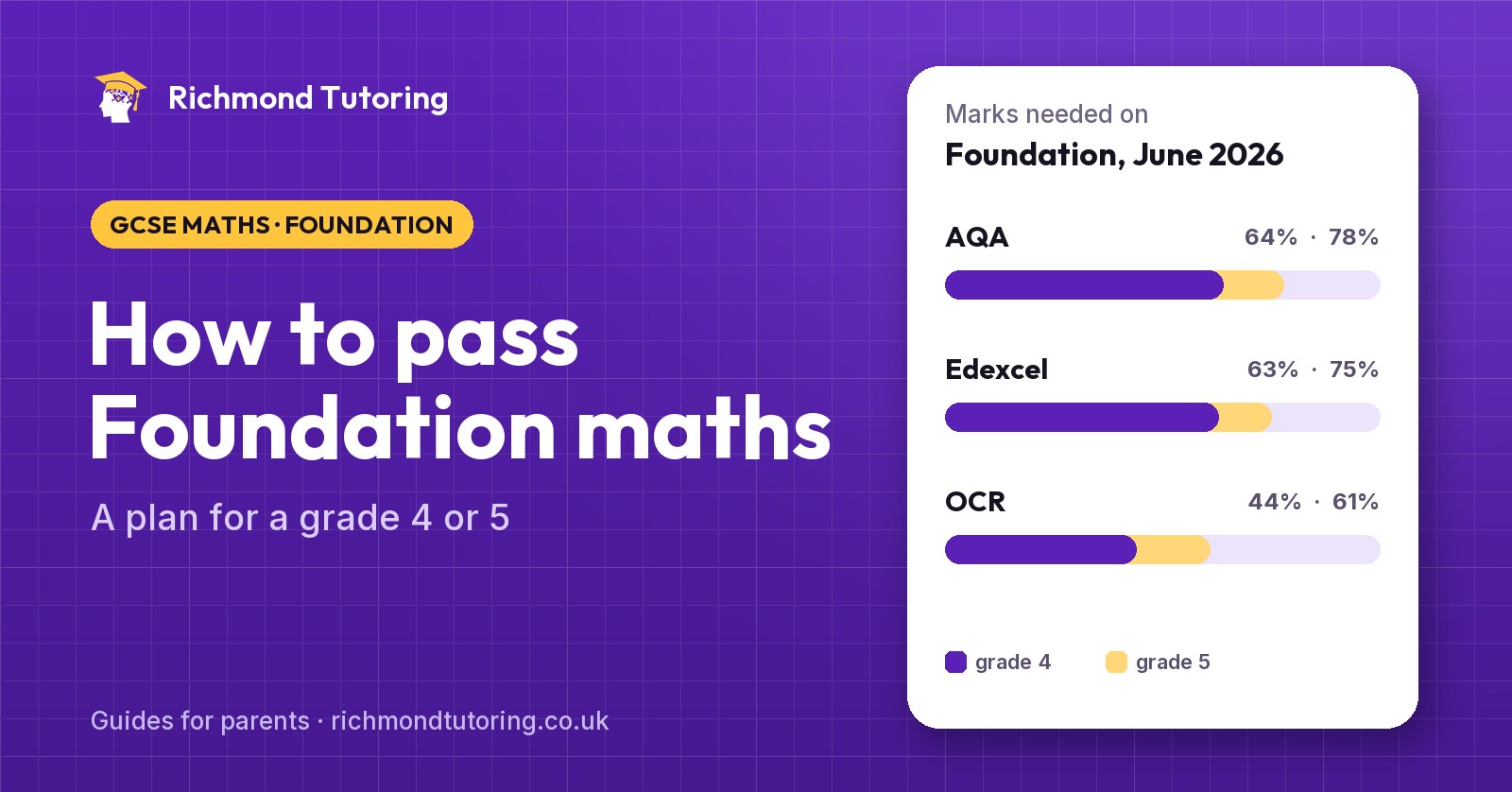
This is the part most parents do not know, and it explains why the decision is not as simple as "Higher is better". Here are the official grade boundaries from the June 2026 exams, as a share of the total marks:
| Exam board | Foundation grade 4 | Foundation grade 5 | Higher grade 3 | Higher grade 4 | Higher grade 5 |
|---|---|---|---|---|---|
| AQA (240 marks) | 154 (64%) | 187 (78%) | 46 (19%) | 63 (26%) | 97 (40%) |
| Pearson Edexcel (240 marks) | 151 (63%) | 181 (75%) | 34 (14%) | 50 (21%) | 82 (34%) |
| OCR (300 marks) | 133 (44%) | 183 (61%) | 38 (13%) | 57 (19%) | 94 (31%) |
At first glance, Higher looks like the easy option: a grade 4 on Edexcel Higher took just 21% of the marks, against 63% on Foundation. But the boundaries are low because the questions are much harder. Most of the marks on a Higher paper are for grade 6 to 9 work — a student working at grade 4 can only realistically reach the easier questions, and has to get almost all of them right.
Two things follow from the table:
- On Foundation, grade 5 needs a very high score — between 61% and 78% of every mark on the papers. Careless errors cost grades, so accuracy and speed matter as much as knowledge.
- On Higher, the margin between a grade 4 and a U is narrow. On AQA, the gap between an allowed grade 3 (46 marks) and a grade 4 (63 marks) was 17 marks out of 240. A bad day on one paper can take a borderline student below the grade 3 line.
Grade boundaries change every year, so treat these as a guide rather than a promise. You can compare other years and boards with our free GCSE Maths grade calculator.
What is different in the content
Higher tier includes everything on Foundation, and then more. The extra topics are mostly algebra and geometry, and they are what the grade 6 to 9 questions are built on. They include:
- Algebra: the quadratic formula and completing the square, simultaneous equations where one is a quadratic, algebraic fractions, functions and iteration, algebraic proof
- Number: surds, fractional indices, upper and lower bounds in calculations
- Geometry: circle theorems, the sine and cosine rules, the area of a triangle using ½ab sin C, vector proofs
- Statistics and probability: histograms, cumulative frequency and box plots, conditional probability
The style is different too. On Foundation, half of the marks test standard techniques; on Higher, it is 40%, and the rest — 60% — goes on reasoning and problem solving, often in unfamiliar, multi-step questions. A student who is fine with methods but freezes on wordy problems may find Higher papers harder than their classwork suggests.
Which tier is right for your child?
There is no single rule, but these are the signs we look for.
Higher is usually the right choice if your child:
- is scoring grade 5 or above on Higher mock papers, reliably rather than once
- needs a grade 6 or 7 for their next step — most sixth forms ask for a 6 or 7 to study A-Level Maths, and many ask for a 6 in maths for A-Level sciences, economics or psychology
- copes well with algebra, and has time before the exam to learn the Higher-only topics
Foundation is usually the right choice if your child:
- is scoring grade 3 or low grade 4 on Higher mocks, but a comfortable 4 or 5 on Foundation mocks
- needs a pass — grade 4 or 5 — for their next step, and a higher grade would not change their options
- loses confidence quickly with hard questions; Foundation papers let them show what they know
If they are on the 4/5 borderline, compare their results on both tiers rather than one mock. As a rough guide, a student who is scoring well above the Foundation grade 5 boundary — around 80% or more — is probably ready for Higher, because there is no further grade available to them on Foundation. A student who scrapes a 4 on Higher papers would often get a more secure 5 on Foundation, with less risk of a U. Our free GCSE Maths check gives an estimated grade on either tier in 25 minutes, which is a quick way to see how the two compare.
Want a second opinion? Book a free 45-minute demo class with a specialist tutor — no contract, and an honest view of what your child needs.
Book a free demo classPast papers for each tier
Past papers are the most reliable way to see which tier suits your child — and the tier is printed on every paper, so make sure you are using the right ones:
| Exam board | Foundation papers | Higher papers | Where to find them |
|---|---|---|---|
| AQA (8300) | 1F, 2F, 3F | 1H, 2H, 3H | AQA past papers and mark schemes |
| Pearson Edexcel (1MA1) | 1F, 2F, 3F | 1H, 2H, 3H | Pearson past papers |
| OCR (J560) | Papers 1, 2, 3 | Papers 4, 5, 6 | OCR assessment materials |
For a fair test, your child should sit a full set of three papers, timed, and without help. Mark them with the official mark scheme, then put the total into our grade calculator to see the grade on the real boundaries. If they are on the borderline, try one full set of each tier: the tier where they would get the higher secure grade is usually the right one.
Would rather not mark them yourself? Send the papers to us for a free GCSE Maths paper analysis: a specialist tutor marks every question and sends back a predicted grade and the topics to work on.
Who decides, and when
The school decides, and makes the exam entry — but you can, and should, talk to them about it. Most schools set the tier using Year 10 and Year 11 mock results, alongside the maths teacher's view.
The timing matters:
- Entries for the June exams are due in the spring of Year 11. Pearson's entry deadline for the June 2026 exams was 21 February 2026, and the other boards work to similar dates.
- Tiers can still change after that. Pearson did not charge schools for a tier change until 22 April 2026, so a decision made after the spring mocks can usually still be acted on. After that date the school pays an amendment fee, and late changes become less likely.
- Some schools decide much earlier, in Year 10, when they set classes. If your child is in a Foundation set but is now doing well, ask what it would take to move to Higher — the extra topics take time to teach, so the earlier the better.
Questions worth asking your child's maths teacher:
- Which tier are they entered for, and what grade do you expect on that tier?
- What were their marks on each tier in their last mock?
- Is there a chance of a U if they sit Higher?
- If they are on Foundation, is a grade 5 realistic, and what is holding them back?
- When is the final decision made?
What happens if your child does not get a grade 4?
In England, students who finish Year 11 without at least a grade 4 in maths must keep studying maths after 16 as part of their sixth form, college or apprenticeship course. A student with a grade 3 must work towards the GCSE again; a student with grade 2 or below can work towards Functional Skills Level 2 instead, or towards the GCSE. Resits are available in November (for students aged 16 or over) and in June.
That is why the tier decision matters for students on the grade 4 borderline: a secure 4 on Foundation can be worth far more than a hoped-for 5 on Higher that turns into a 3 or a U.
Common myths
"Higher is always better." Only if your child can access enough of the paper. A grade 5 is a grade 5 whichever tier it came from — sixth forms, colleges and employers look at the grade, not the tier.
"Foundation means the school has given up on my child." It usually means the school is protecting a pass. Foundation is the right choice for a large number of students, and a grade 5 on Foundation is a strong pass.
"If they do badly on Higher, they will still get a 3." Only if they narrowly miss the grade 4 boundary. Below the grade 3 boundary, the result is a U.
"The tier is fixed once they are in a set." Not until the exam entry is finalised in the spring of Year 11. Progress in Year 10 and 11 can change the decision in either direction.
The bottom line
Choose the tier that gives your child the best secure grade, not the best possible one. For a student heading for a 6 or more, that is Higher. For a student working towards a 4 or 5, Foundation is often the smarter route — and the one that keeps their options open after 16.
If you are unsure where your child stands, a specialist GCSE maths tutor can tell you quickly, from a real past paper and a lesson. Or send us their past papers for a free paper analysis, marked by a tutor, with a predicted grade on their tier.