Grade boundaries are the marks a student needed for each grade. They're set after the exams are marked, so they change every year. This guide gives the June 2026 GCSE grade boundaries for Maths, Combined Science, Biology, Chemistry, Physics and Computer Science for AQA, Pearson Edexcel and OCR. It also explains how boundaries work, when the 2027 ones come out and how to use them to set a realistic target for each paper.
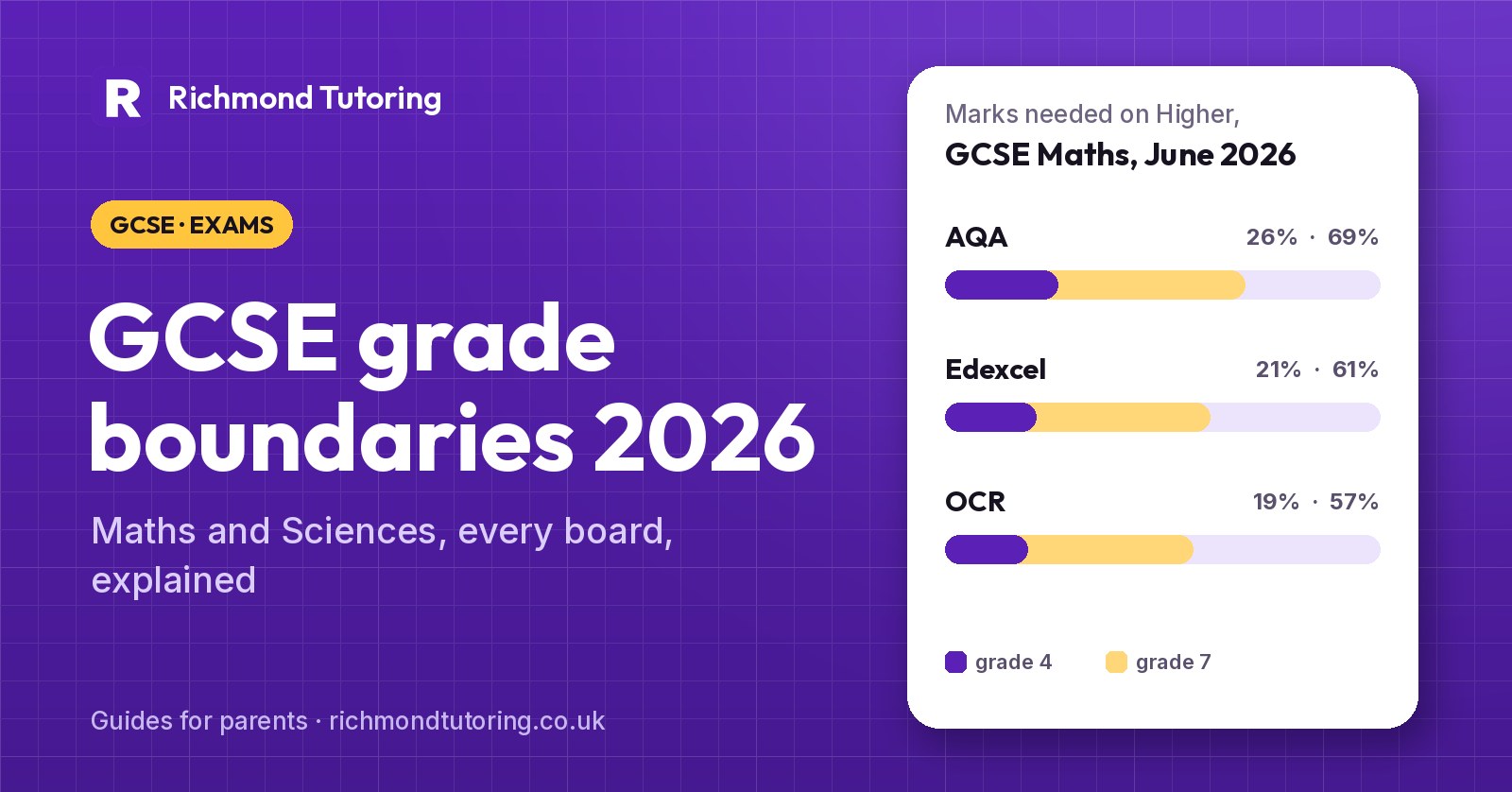
The short answer: In June 2026, a grade 4 in GCSE Maths took between 19% and 26% of the marks on Higher, and between 44% and 64% on Foundation, depending on the exam board. A grade 7 on Higher took between 57% and 69%. Boundaries are published on results day, so the 2027 boundaries will come out on Thursday 19 August 2027. Boundaries for the November 2026 resits come out on 14 January 2027.
How do GCSE grade boundaries work?
Every GCSE paper is marked out of a fixed number of raw marks. After marking, the exam board decides the minimum total mark for each grade. That minimum mark is the grade boundary.
A few things to know:
- They're set after the exams, not before. Senior examiners look at students' work, statistics on how the year group did in previous years, and how hard the papers turned out to be. Ofqual oversees the process so that a grade 4 this year is worth the same as a grade 4 last year.
- They change every year. If a paper was harder than usual, the boundaries go down. If it was easier, they go up. A change of a few marks is normal.
- The grade comes from the total, not each paper. In Maths, the marks from all three papers are added together and the total is compared with the boundaries. A weak paper can be made up for on another.
- Grades run from 9 (highest) to 1. A grade 4 is a standard pass and a grade 5 a strong pass. Our guide on what a pass in GCSE Maths is explains what these mean for sixth form and college.
- Tiers cap the grades. Foundation papers give grades 1 to 5. Higher papers give grades 4 to 9, with an allowed grade 3 for students who just miss a 4. Our guide to Foundation vs Higher explains how schools choose.
The percentages look very different between tiers and boards because the papers are different. A low boundary on Higher doesn't mean a 4 is easier to get on Higher. It means the Higher papers are harder, so fewer marks are needed.
GCSE Maths grade boundaries 2026
These are the overall boundaries for June 2026, with June 2025 in brackets for comparison. AQA and Edexcel Maths are out of 240 marks across three papers, and OCR is out of 300.
Higher tier
| Board | Grade 9 | Grade 7 | Grade 5 | Grade 4 |
|---|---|---|---|---|
| AQA (8300H), out of 240 | 219, 91% (219) | 166, 69% (164) | 97, 40% (96) | 63, 26% (63) |
| Pearson Edexcel (1MA1H), out of 240 | 208, 87% (217) | 146, 61% (156) | 82, 34% (87) | 50, 21% (53) |
| OCR (J560H), out of 300 | 264, 88% (258) | 170, 57% (166) | 94, 31% (86) | 57, 19% (47) |
Foundation tier
| Board | Grade 5 | Grade 4 |
|---|---|---|
| AQA (8300F), out of 240 | 187, 78% (188) | 154, 64% (160) |
| Pearson Edexcel (1MA1F), out of 240 | 181, 75% (175) | 151, 63% (144) |
| OCR (J560F), out of 300 | 183, 61% (182) | 133, 44% (134) |
What stands out:
- AQA was almost unchanged from 2025, except a grade 4 on Foundation, which dropped six marks.
- Edexcel Higher came down at every grade, by nine marks at grade 9 and ten at grade 7. That points to harder Higher papers in 2026. Foundation went the other way, up seven marks for a grade 4.
- OCR Higher went up by ten marks at grade 4 and eight at grade 5.
If your child has a mark for each paper but no grade, the free GCSE Maths grade calculator turns paper marks into a grade using the real AQA, Edexcel and OCR boundaries.
GCSE Combined Science grade boundaries 2026
Combined Science is a double award. Students get two grades, such as 5-5 or 5-4, and the boundaries are given for each step. These are the main steps for June 2026.
| Board | 9-9 | 7-7 | 5-5 | 4-4 |
|---|---|---|---|---|
| AQA Trilogy Higher (8464H), out of 420 | 298, 71% | 228, 54% | 149, 35% | 111, 26% |
| Edexcel Higher (1SC0), out of 360 | 282, 78% | 221, 61% | 145, 40% | 108, 30% |
| OCR Gateway A Higher (J250), out of 360 | 275, 76% | 222, 62% | 154, 43% | 121, 34% |
| Board | 5-5 | 4-4 |
|---|---|---|
| AQA Trilogy Foundation (8464F), out of 420 | 276, 66% | 238, 57% |
| Edexcel Foundation (1SC0), out of 360 | 231, 64% | 194, 54% |
| OCR Gateway A Foundation (J250), out of 360 | 209, 58% | 174, 48% |
Combined Science has six papers, two each in biology, chemistry and physics. As in Maths, the total counts, so a strong physics paper can make up for a weaker biology one. Our guide to Triple vs Combined Science explains how the two routes differ.
GCSE Biology, Chemistry and Physics grade boundaries 2026
For students taking the separate sciences (Triple Science), each subject is a full GCSE. AQA and Edexcel papers total 200 marks per subject, and OCR Gateway A papers total 180.
Higher tier
| Subject and board | Grade 9 | Grade 7 | Grade 5 | Grade 4 |
|---|---|---|---|---|
| Biology, AQA (8461H) | 133, 67% | 107, 54% | 70, 35% | 52, 26% |
| Biology, Edexcel (1BI0) | 170, 85% | 147, 74% | 105, 53% | 84, 42% |
| Biology, OCR A (J247) | 141, 78% | 121, 67% | 86, 48% | 69, 38% |
| Chemistry, AQA (8462H) | 155, 78% | 120, 60% | 68, 34% | 43, 22% |
| Chemistry, Edexcel (1CH0) | 165, 83% | 127, 64% | 79, 40% | 55, 28% |
| Chemistry, OCR A (J248) | 163, 91% | 139, 77% | 97, 54% | 76, 42% |
| Physics, AQA (8463H) | 157, 79% | 128, 64% | 87, 44% | 67, 34% |
| Physics, Edexcel (1PH0) | 163, 82% | 134, 67% | 92, 46% | 71, 36% |
| Physics, OCR A (J249) | 152, 84% | 131, 73% | 97, 54% | 80, 44% |
Foundation tier
| Subject and board | Grade 5 | Grade 4 |
|---|---|---|
| Biology, AQA (8461F) | 144, 72% | 127, 64% |
| Biology, Edexcel (1BI0) | 132, 66% | 115, 58% |
| Biology, OCR A (J247) | 112, 62% | 93, 52% |
| Chemistry, AQA (8462F) | 132, 66% | 110, 55% |
| Chemistry, Edexcel (1CH0) | 137, 69% | 118, 59% |
| Chemistry, OCR A (J248) | 120, 67% | 100, 56% |
| Physics, AQA (8463F) | 141, 71% | 126, 63% |
| Physics, Edexcel (1PH0) | 135, 68% | 118, 59% |
| Physics, OCR A (J249) | 123, 68% | 108, 60% |
The spread is wide. A grade 7 in AQA Biology took 54% of the marks, while the same grade in OCR Chemistry took 77%. That reflects how hard each set of papers was, not how hard the subject is. It's one reason to judge progress on the board your child is actually sitting.
GCSE Computer Science grade boundaries 2026
Computer Science has no tiers, so every student sits the same papers and can get any grade from 9 to 1.
| Board | Grade 9 | Grade 7 | Grade 5 | Grade 4 |
|---|---|---|---|---|
| AQA (8525), out of 180 | 160, 89% | 136, 76% | 93, 52% | 72, 40% |
| Pearson Edexcel (1CP2), out of 150 | 118, 79% | 88, 59% | 60, 40% | 46, 31% |
| OCR (J277), out of 160 | 141, 88% | 124, 78% | 92, 58% | 77, 48% |
Where the numbers come from
All the figures above are from the exam boards' own June 2026 documents:
- AQA GCSE grade boundaries, June 2026 (published 20 August 2026)
- Pearson Edexcel GCSE grade boundaries, June 2026
- OCR GCSE grade boundaries, June 2026
Each document covers every GCSE the board offers, so you can look up other subjects there too.
When do the 2027 grade boundaries come out?
Exam boards publish grade boundaries on results day, at the same time as the results:
| Exams | Boundaries published |
|---|---|
| November 2026 resits (Maths and English) | Thursday 14 January 2027 |
| June 2027 GCSEs | Thursday 19 August 2027 (JCQ key dates) |
No one knows the 2027 boundaries in advance, including teachers. Any website quoting "2027 grade boundaries" before August 2027 is guessing. The best guide is the last few years, which is why we show 2025 next to 2026 for Maths. Our GCSE exam dates 2027 guide has the full exam timetable.
If your child is resitting Maths this November, our GCSE Maths resit guide covers the rules and how to prepare. Note that November boundaries are set separately and are often different from June's.
How schools use grade boundaries in mocks
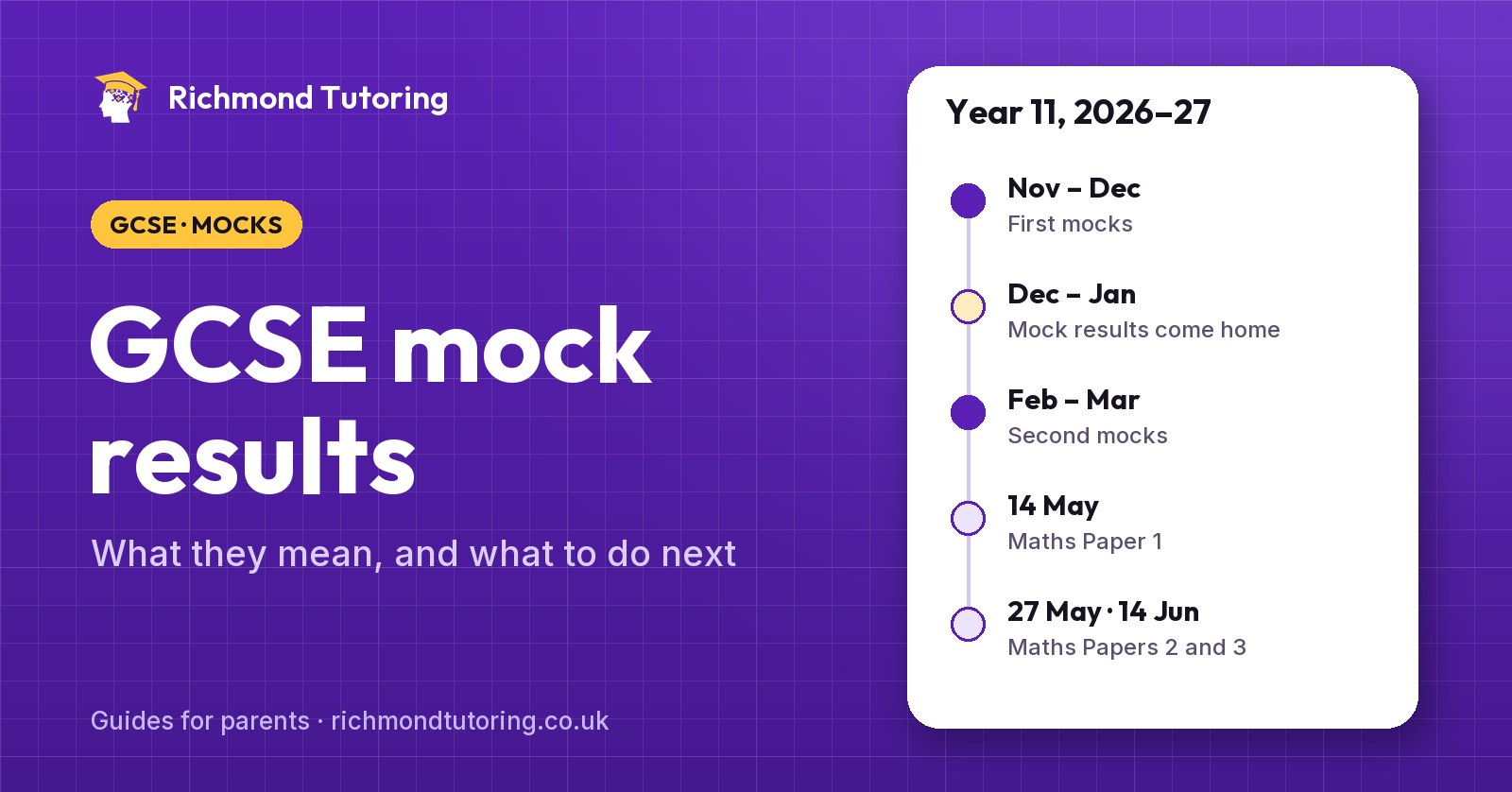
Mock exams are marked by teachers, and the grade comes from a previous year's boundaries, usually the most recent June series. So a mock grade this winter will probably be based on the 2026 boundaries in this guide.
Keep three things in mind:
- The course isn't finished. In November or December, some topics haven't been taught yet, so some marks were never available.
- Some schools grade a little harshly on purpose, to avoid complacency.
- One mock series often uses older or practice papers, which may not match the difficulty of the year the boundaries came from.
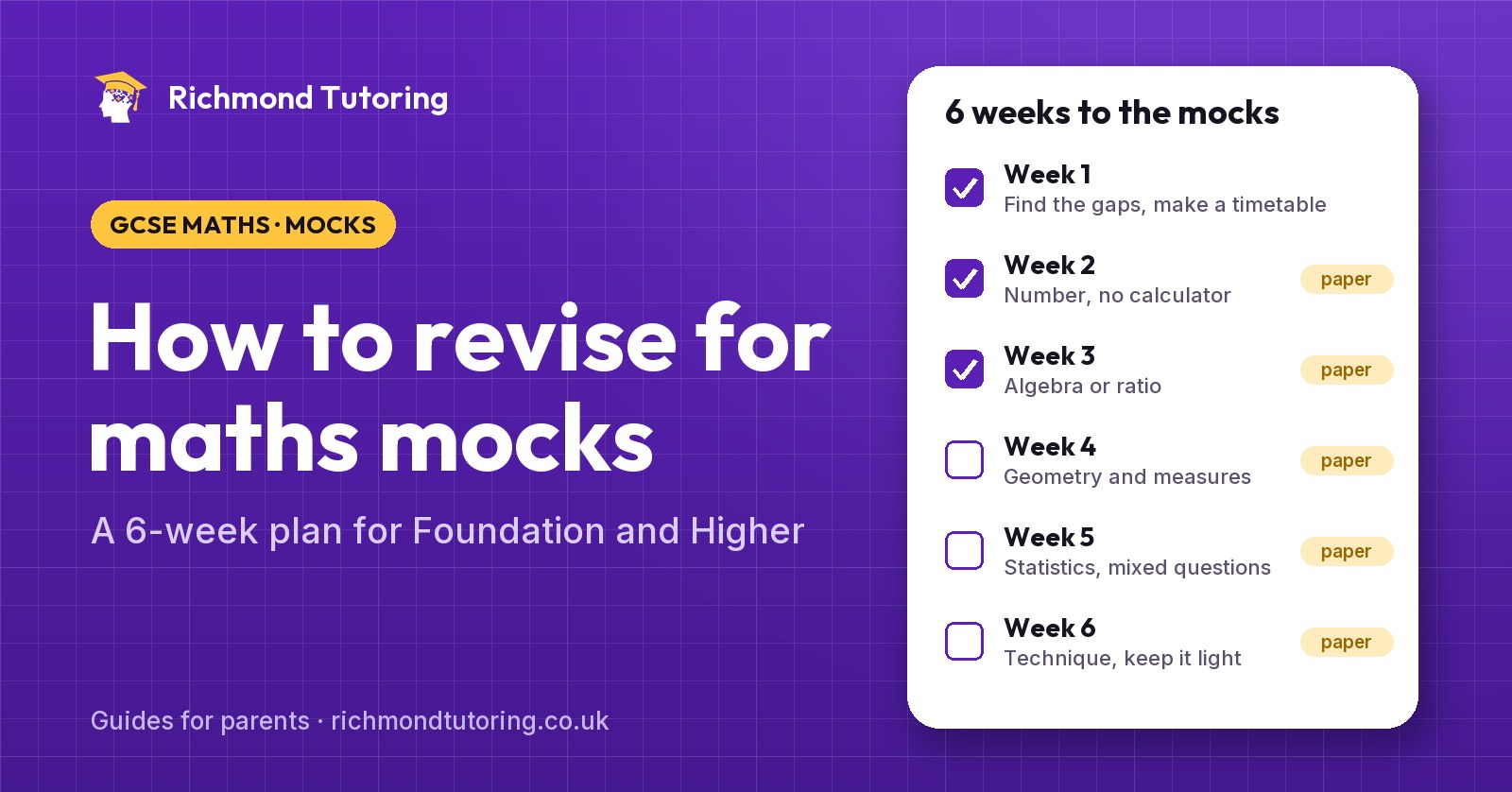
Our guide to GCSE mock results explains how to read a mock grade, and the 6-week mock revision plan covers the run-up. Mock grades also feed into predicted grades for sixth form applications.
How to use grade boundaries to set a target
Boundaries are most useful when you turn them into marks per paper. Divide the overall boundary by the number of papers and round up:
- AQA Maths Foundation, grade 4: 154 out of 240 is about 52 marks out of 80 on each paper.
- Edexcel Maths Higher, grade 5: 82 out of 240 is about 28 marks out of 80 on each paper.
- AQA Trilogy Higher, grade 5-5: 149 out of 420 is about 25 marks out of 70 on each paper.
Then:
- Find your child's board and tier. The school can tell you, or check the front of a mock paper. The same mark can mean different grades on different boards.
- Use the most recent June boundaries, with a margin of five to ten marks across the whole qualification in case they rise.
- Practise on full past papers under timed conditions and compare the totals with the boundaries. Our list of GCSE Maths past papers has every board and tier.
- Work out where the missing marks are. On Foundation, the gap between a grade 3 and a grade 4 is often around 40 marks across three papers, roughly 13 a paper. Our plan for how to pass GCSE Maths Foundation shows which topics carry the most marks.
Want a second opinion? Book a free 45-minute demo class with a specialist tutor — no contract, and an honest view of what your child needs.
Book a free demo classWant a second opinion on where your child stands?
- The free GCSE Maths check takes 25 minutes and gives an estimated grade and the topics to work on first.
- The free GCSE Maths paper analysis: send us papers your child has already sat (a school mock, past papers or exam scripts returned by the school, from any board), and one of our tutors marks every question and sends a report with a predicted grade and a topic breakdown.
- The GCSE Maths grade calculator turns paper marks into a grade on real boundaries.
- The free GCSE Science quiz takes about 7 minutes: ten questions on your child's board (AQA, Edexcel or OCR), in Combined Science or Biology, Chemistry or Physics, showing which topics are secure and which are gaps.
- A free 45-minute demo class with a GCSE maths tutor, a GCSE science tutor or a GCSE computer science tutor. We also teach physics, chemistry and biology separately.
The bottom line
Grade boundaries are set after the exams and move every year, usually by a few marks. The June 2026 boundaries are the best guide to what your child will need in 2027, but no one will know the real 2027 numbers until 19 August 2027. Find out which board and tier your child is sitting, turn the boundary into a target for each paper, and add a margin of safety. Then use past papers to see how far there is to go.