Past papers are the single most useful revision tool for GCSE Maths — as long as your child uses the right ones, in the right way. This guide shows where to find free, official GCSE Maths past papers and mark schemes for AQA, Pearson Edexcel and OCR, at Foundation and Higher tier, and how to turn them into a better grade.
The short answer: every exam board publishes its GCSE Maths past papers and mark schemes free on its own website — links are in the table below. Your child needs papers for their board and their tier, sat as a full set of three, timed, and marked with the official mark scheme. You can download the latest Pearson Edexcel set from our free paper analysis page, and a tutor will mark them for you.
First, check the board and the tier
GCSE Maths papers look similar, but your child should practise on the ones they will actually sit.
- The exam board. Most schools in England use AQA, Pearson Edexcel or OCR. If you are not sure, ask the maths teacher, or look at the front cover of a mock paper.
- The tier. Foundation papers lead to grades 1 to 5; Higher papers lead to grades 4 to 9. The tier is printed on every paper. If your child's tier is not decided yet, our guide to Foundation vs Higher explains the choice.
The paper codes tell you both at a glance:
| Exam board | Foundation papers | Higher papers | Calculator |
|---|---|---|---|
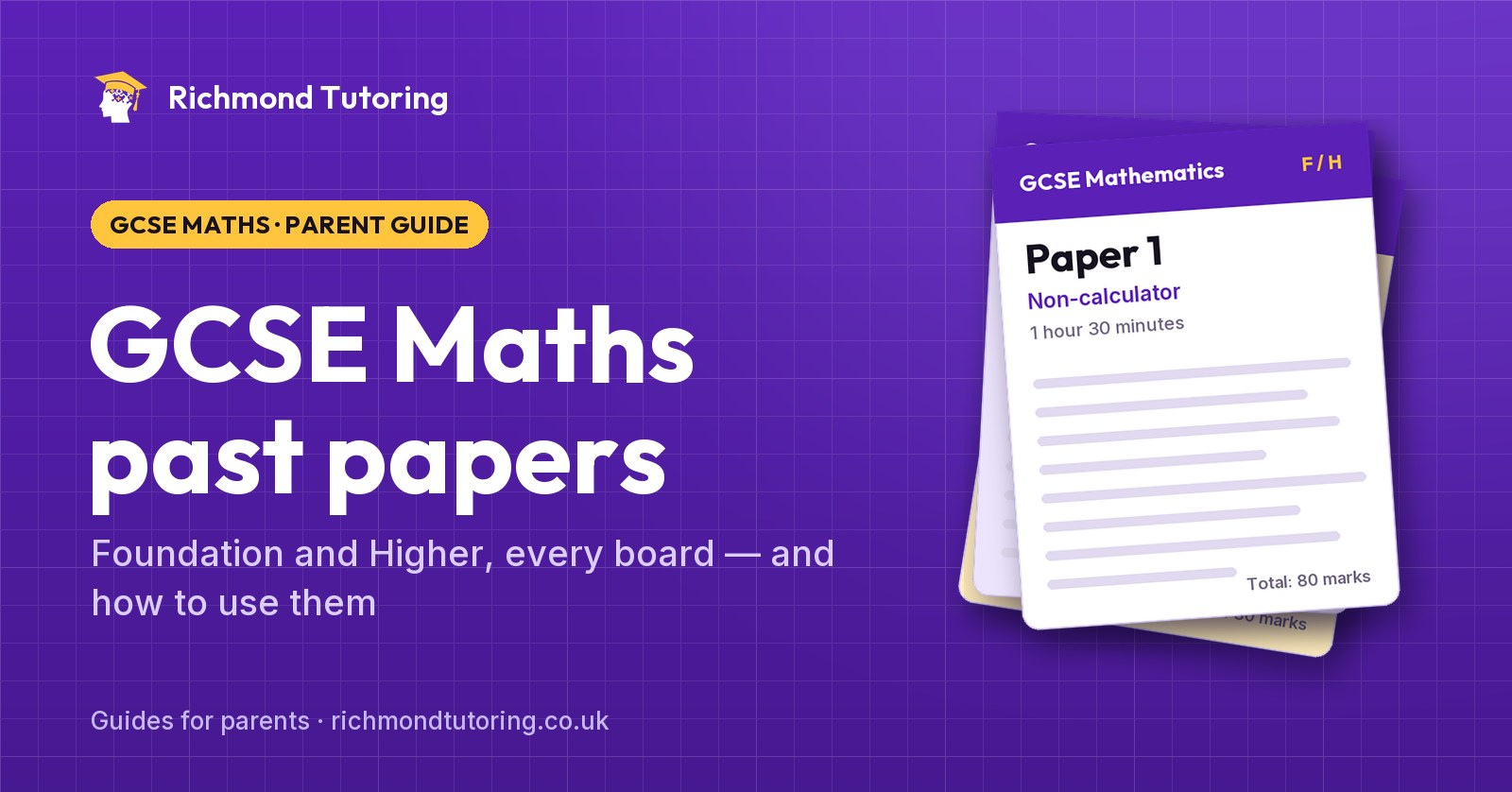
| AQA (8300) | 1F, 2F, 3F | 1H, 2H, 3H | Paper 1 is non-calculator; 2 and 3 calculator |
| Pearson Edexcel (1MA1) | 1F, 2F, 3F | 1H, 2H, 3H | Paper 1 is non-calculator; 2 and 3 calculator |
| OCR (J560) | Papers 1, 2, 3 | Papers 4, 5, 6 | The middle paper (2 or 5) is non-calculator |
Every paper is 1 hour 30 minutes. AQA and Pearson Edexcel papers are out of 80 marks (240 in total); OCR papers are out of 100 (300 in total).
Where to find official past papers
The exam boards' own websites are the best source. They are free, complete, and come with the official mark schemes and examiners' reports.
| Exam board | Where to find them | What is there |
|---|---|---|
| AQA | AQA GCSE Maths 8300 assessment resources | Question papers, mark schemes and examiners' reports, usually for the last three years |
| Pearson Edexcel | Pearson past papers | Choose "GCSE", "Mathematics (2015)" and the series you want |
| OCR | OCR J560 assessment materials | Question papers, mark schemes and examiners' reports |
A few things worth knowing:
- The current GCSE (graded 9 to 1) was first sat in June 2017, so papers from 2017 onwards match today's course. Older papers (graded A* to G) cover a different syllabus and are best avoided, except for the odd topic question.
- There were no summer exams in 2020 or 2021, so those years are missing. There were November resit papers in both years, which make good extra practice.
- The newest papers can take a while to appear. Schools usually get the latest papers first, and use them as mock exams. If your child's school has used a paper for a mock, choose a different one for home practice.
- Specimen and practice papers (sometimes called sample assessment materials) are also free on each board's website. They are written in the style of the real exam and are handy once the real papers run out.
How to use past papers properly
Doing past papers is not the same as revising with them. The difference is in what happens after the paper is finished.
- Sit a full set of three papers, timed. Use the real time limits — 1 hour 30 minutes each — and the right equipment: calculator, protractor, compasses. No notes, no phone, no help.
- Mark it with the official mark scheme. Be strict. Mark schemes award M marks for a correct method, A marks for accurate answers (which usually depend on the method being there) and B marks for independent results. A right answer with no working can lose marks; a wrong answer with good working can still earn some.
- Work out the grade. Add up the total and use our free GCSE Maths grade calculator to see the grade on the real grade boundaries from recent years.
- Keep a list of the questions that went wrong, by topic. After two or three papers, the same topics usually appear again and again — those are the ones to work on.
- Fix the gaps, then try again. Learn the method for each wrong question, then redo it a week later without looking. This is where the grade actually improves.
- Read the examiners' reports. They explain the mistakes most students made on each question — often the same mistakes your child made.
How many papers, and when
There is no need to start on full papers in Year 10. Topic practice is more useful while the course is still being taught. A sensible pattern for Year 11:
| When | What to do |
|---|---|
| Autumn term | One full set every half term, to find the gaps |
| Spring term | A set every two to three weeks, alongside topic revision |
| After Easter | A paper or a set every week, timed, and marked the same day |
| Last month | Keep one unseen set back as a final "dress rehearsal" |
For most students, eight to twelve full sets across Year 11 is plenty — quality of marking matters more than quantity.
Mistakes to avoid
- Only doing the early questions. The first half of each paper is easier. The marks that move a grade are usually in the second half.
- Looking at the mark scheme too early. If the answer is on the table while the paper is being done, it is not a test.
- Untimed practice only. Time pressure is part of the exam. Most students need to practise finishing in 90 minutes.
- The wrong tier or board. Other boards' papers are fine for extra practice — the content is the same across boards — but the grade boundaries and question styles differ, so use your own board to judge a grade.
- Doing papers but not fixing mistakes. Ten papers with no follow-up will help less than four with careful correction.
Want a second opinion? Book a free 45-minute demo class with a specialist tutor — no contract, and an honest view of what your child needs.
Book a free demo classWant a tutor to mark them? It is free
Marking a Maths paper properly is harder than it looks — method marks especially. Our free GCSE Maths paper analysis does it for you:
- Download the most recent Pearson Edexcel papers (Foundation or Higher) from the page.
- Your child sits them at home, timed.
- Upload photos of the answers.
- A specialist GCSE maths tutor marks every question and sends back a predicted grade, a topic-by-topic breakdown and what to work on first.
Short of time? Our free GCSE Maths check gives an estimated grade and a strengths-and-gaps chart in 25 minutes.
The bottom line
Use official papers from your child's own board and tier, sit them as full timed sets, mark them strictly, and spend as long fixing the mistakes as doing the paper. That is how past papers turn into marks.