If your child is applying to study maths, economics or computer science at a top UK university, they may need to sit the TMUA as well as getting the A-Level grades. It's a short, demanding maths test taken before offers are made, and for some courses a good score matters as much as the predicted grades. This guide explains what the TMUA is, who needs it, the 2026–27 dates and deadlines, how it's scored and how to prepare.
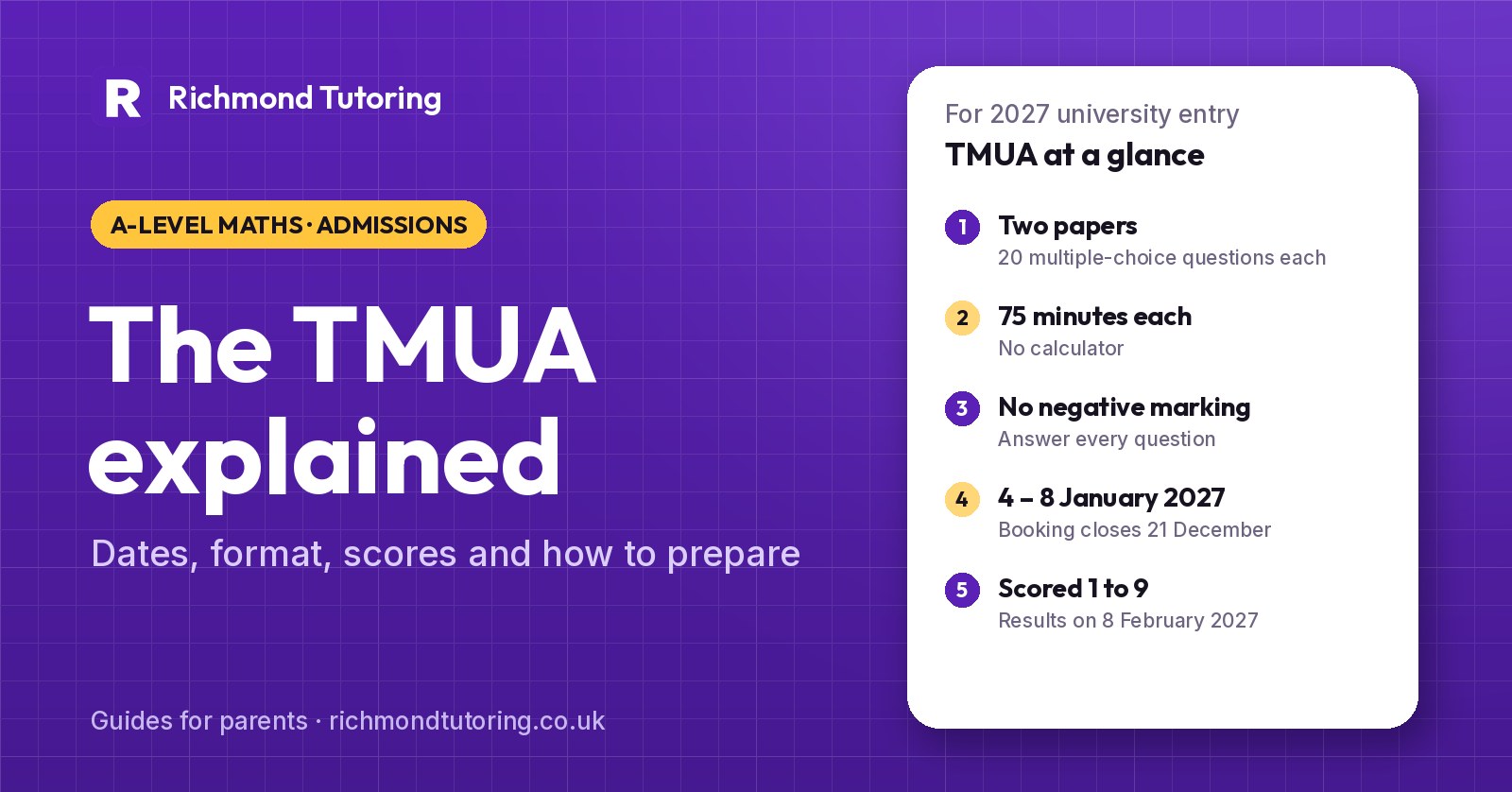
The short answer: The TMUA (Test of Mathematics for University Admission) is a 2½-hour, multiple-choice, non-calculator maths test used by seven universities for maths, economics and computer science courses. For 2027 entry it runs in two windows: 12–16 October 2026 (the only option for most Oxford and Cambridge applicants) and 4–8 January 2027. Booking for January opens on 26 October 2026 and closes at 6pm on 21 December 2026. It costs £78 in the UK, and scores run from 1 to 9.
What is the TMUA?
The TMUA is an admissions test that checks how well a student thinks mathematically, not just how much maths they know. It's run by UAT-UK, a group of universities that set their own admissions tests, and it's taken on a computer at a Pearson VUE test centre.
It's based on content from Higher tier GCSE Maths and AS Level Maths, so most Year 13 students will have met all of it. What makes it hard is the way the questions are asked: unfamiliar set-ups, no calculator, and logic and proof questions that school exams rarely test directly.
Which universities and courses use the TMUA?
For 2027 entry, the official UAT-UK course list names seven universities. Whether the test is compulsory or recommended depends on the course.
| University | Courses using the TMUA | Compulsory or recommended? |
|---|---|---|
| University of Cambridge | Mathematics, Computer Science, Economics | Compulsory |
| University of Oxford | Mathematics, Mathematics and Statistics, Computer Science, Maths and Computer Science, Maths and Philosophy, Computer Science and Philosophy | Compulsory |
| Imperial College London | Mathematics degrees, Computing degrees, Economics, Finance and Data Science | Compulsory |
| University of Warwick | Mathematics, Computer Science, Discrete Mathematics | Compulsory (except for students eligible for a contextual offer) |
| University of Warwick | Economics, Data Science, Maths and Statistics, MORSE and related courses | Recommended |
| LSE | Economics, Econometrics and Mathematical Economics | Compulsory |
| LSE | Actuarial Science, Data Science, Financial Maths and Statistics, Maths with Economics and others | Recommended |
| UCL | Economics | Compulsory |
| Durham University | Mathematics, Mathematics and Statistics | Recommended |
Check the course page on each university's website before booking, because requirements can change from one admissions cycle to the next. If a test is compulsory and your child doesn't sit it, the application may not be considered.
Your child only sits the TMUA once per admissions cycle, and the score goes to every TMUA university on their UCAS form for a course that uses it.
When is the TMUA? Dates for 2027 entry
These are the official UAT-UK key dates for students applying in 2026 to start university in 2027.
| What | October sitting | January sitting |
|---|---|---|
| Access arrangements: request by | 14 September 2026 | 7 December 2026, 6pm |
| Bursary: request by | 21 September 2026 | 14 December 2026, 6pm |
| Booking opens | 20 July 2026 | 26 October 2026, 3pm |
| Booking closes | 28 September 2026 | 21 December 2026, 6pm |
| Test window | 12–16 October 2026 | 4–8 January 2027 |
| Results released | 16 November 2026 | 8 February 2027 |
Oxford and Cambridge applicants must sit in October. The only exceptions are mature applicants applying to a Cambridge mature college with a January deadline, and applicants to Oxford's Astrophoria Foundation Year. Students applying elsewhere can choose either sitting, and UAT-UK says there's no advantage to sitting in one rather than the other.
So if your child is applying to Imperial, Warwick, LSE, UCL or Durham and hasn't sat the TMUA yet, the January sitting is still open. Bookings are first come, first served at each test centre, so book soon after 26 October, and UAT-UK doesn't accept bookings after the deadline.
What is in the TMUA? Format and timing
The test lasts 2 hours 30 minutes and has two papers:
| Paper | What it tests | Questions | Time |
|---|---|---|---|
| Paper 1: Applications of Mathematical Knowledge | Using maths you know in new situations | 20 multiple-choice | 75 minutes |
| Paper 2: Mathematical Reasoning | Logic, proof and spotting flawed arguments | 20 multiple-choice | 75 minutes |
Calculators and dictionaries are not allowed, and there's no negative marking, so students should answer every question even when they have to guess.
The TMUA content specification lists the topics. In practice, Paper 1 leans on algebra, functions, graphs, sequences, trigonometry, exponentials and logarithms, and basic calculus. Paper 2 adds the language of logic: "if… then", "necessary and sufficient", counter-examples and finding the error in a proof.
How the TMUA relates to A-Level Maths
Everything in the TMUA is covered by GCSE Higher and AS Maths, so a student in Year 13 doing A-Level Maths already has the content. Further Maths isn't required, though students who take it often find the reasoning questions more familiar.
The difference is the style. A-Level questions usually tell you which method to use. TMUA questions don't, and with 75 minutes for 20 questions there's under four minutes per question. Students who are strong at A-Level can still find the TMUA hard at first. Fast, accurate algebra and mental arithmetic help a lot, because there's no calculator.
How is the TMUA scored, and what is a good score?
Results arrive about four weeks after the test, in the student's UAT-UK account, and are sent automatically to universities on their UCAS form. Students get a single overall score from 1.0 (low) to 9.0 (high), to one decimal place. There's no pass mark. The UAT-UK results page explains that the scale is set so the median is 4.5 and the 90th percentile is 7.0. A score of 4.5 is therefore the middle of a very able group, and 7.0 or above puts a student in the top tenth.
Universities don't publish a single cut-off, and each one weighs the score alongside predicted grades, the personal statement, the reference and, for Oxford and Cambridge, interviews. As a rough guide to the scale:
- 4.5 is the middle of the October group. Half of a very able set of candidates scored below it.
- Above 4.5 puts a student in the top half, which supports an application to most TMUA courses.
- 7.0 and above is in the top 10%, which is where the most competitive applicants to the most selective courses tend to be.
UAT-UK also points out that students shouldn't expect to score as highly as they do in school exams, because the test is designed to separate students who already have top grades.
Scores can't be appealed, and students can only sit once per admissions cycle, so preparation matters.
How to prepare for the TMUA
UAT-UK says the best preparation is getting to know the format and the question style, and it provides free practice materials on its preparation page, including the specification, "Notes on Logic and Proof" and practice tests. A sensible plan for the January sitting, starting now:
- Late October: Read the specification and the logic and proof notes. Do one practice paper untimed to see which topics and question types cause trouble.
- November: Fill content gaps (often logarithms, sequences, trig equations and graph sketching). Practise non-calculator arithmetic and algebra every day, even for ten minutes.
- Early December: Work through Paper 2-style questions on logic and proof. Learn to spot what a question is really asking before calculating anything.
- Mid-December to the test: Full papers under timed conditions, 75 minutes each. Review every mistake, and practise moving on from a question that's taking too long.
A student who does well in A-Level Maths, works through the official practice material and sits several timed papers is well prepared. Paid courses aren't needed, though some students find it useful to go through the trickier reasoning questions with a tutor.
Remember that the TMUA comes on top of Year 13 work and the mocks. Keep up the A-Level revision too, because the offer will still depend on the final grades.
Want a second opinion? Book a free 45-minute demo class with a specialist tutor — no contract, and an honest view of what your child needs.
Book a free demo classWant help with TMUA preparation?
- Our A-Level maths tutors work with Year 13 students on TMUA practice papers alongside the A-Level course, with a focus on non-calculator speed and logic and proof.
- Applying for computer science? Our A-Level computer science tutors can help with the programming and theory side of the application.
- Taking Further Maths as well, or wondering if it's worth it? See our guide to GCSE Further Maths and the A-Level Maths formula booklet.
The bottom line
The TMUA is a 2½-hour, non-calculator maths test used by Cambridge, Oxford, Imperial, Warwick, LSE, UCL and Durham for maths, economics and computer science courses. Oxford and Cambridge applicants sat it in October. Everyone else can still book the January sitting from 26 October to 21 December 2026, and sit it on 4–8 January 2027. The content is GCSE Higher and AS Maths, but the questions need careful reasoning, so start with the official practice material, fix the gaps and finish with timed papers. A score around 4.5 is typical, and 7.0 or above is in the top 10%.