Passing GCSE Maths Foundation is less about being "good at maths" and more about collecting enough marks from the topics that come up every year. This guide shows how many marks a grade 4 or 5 actually takes, where those marks are on the paper, and a simple plan to get there — whether your child is in Year 11 or preparing for a resit.
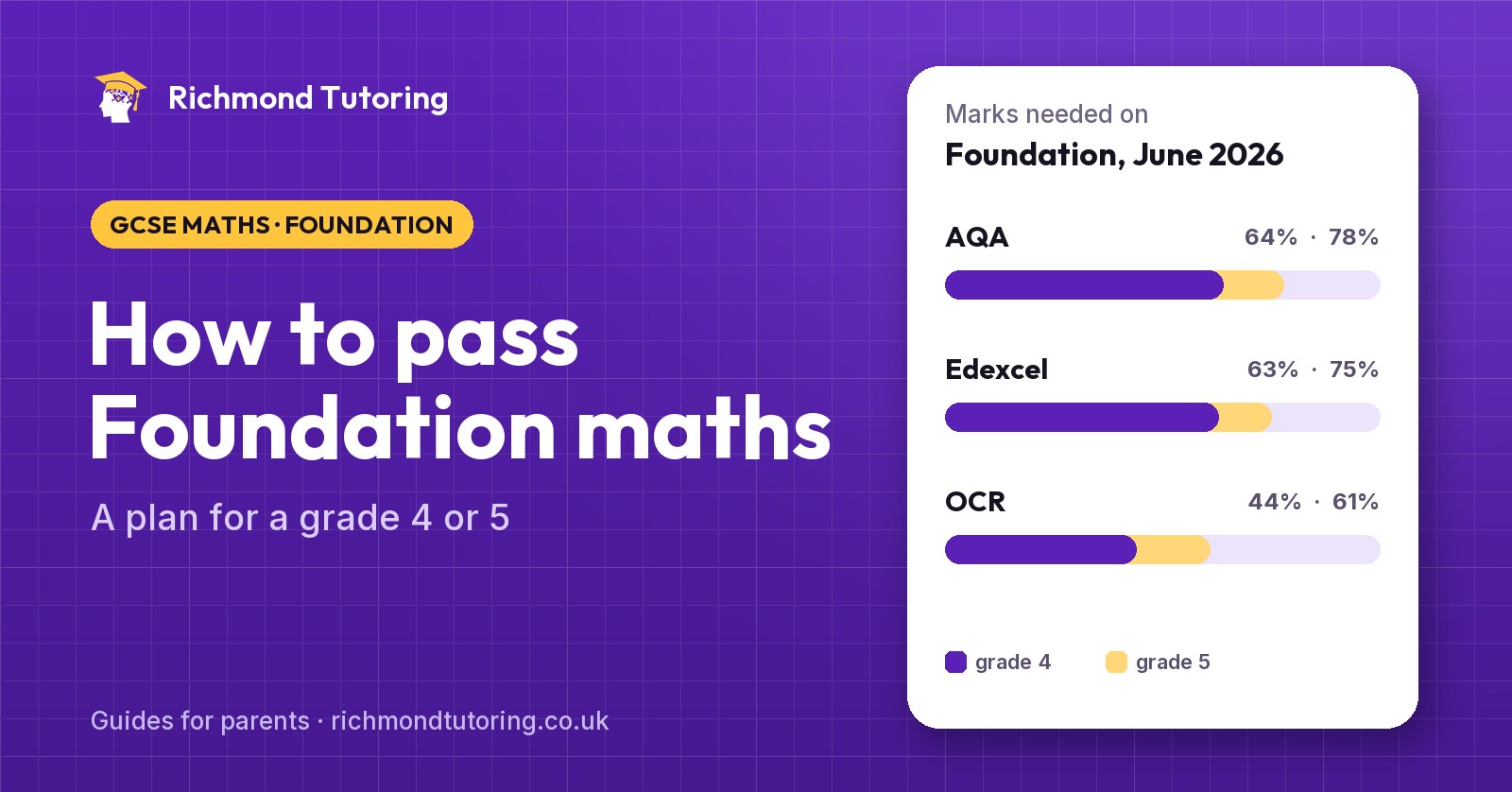
The short answer: in the June 2026 exams, a grade 4 on Foundation needed between 44% (OCR) and 64% (AQA) of the marks, and a grade 5 between 61% and 78%. Half of every Foundation paper is number and ratio — fractions, percentages, ratio and proportion. Secure those first, show your working for method marks, and practise with full timed papers.
How many marks does a pass take?
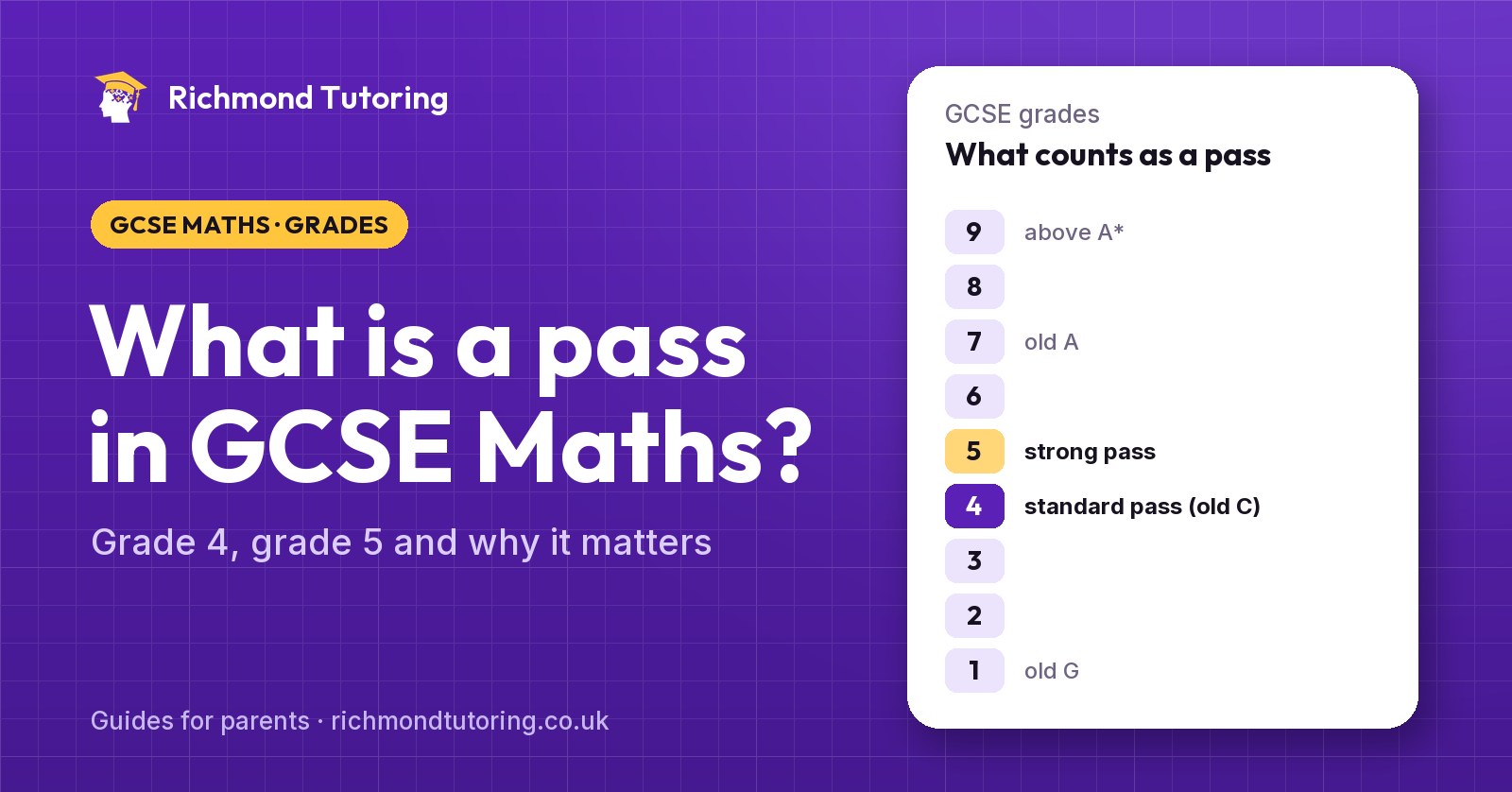
Grade 4 is a "standard pass" and grade 5 a "strong pass". Here is what they took on the June 2026 Foundation papers:
| Exam board | Grade 4 | Grade 5 | Grade 4, per paper (roughly) |
|---|---|---|---|
| AQA (240 marks) | 154 (64%) | 187 (78%) | about 51 out of 80 |
| Pearson Edexcel (240 marks) | 151 (63%) | 181 (75%) | about 50 out of 80 |
| OCR (300 marks) | 133 (44%) | 183 (61%) | about 44 out of 100 |
Two things stand out. First, the target is high: on AQA and Edexcel, a grade 4 means getting nearly two-thirds of everything right. Second, there is not much room between grades — careless slips on easy questions cost more than leaving the hardest ones out.
Boundaries move a little each year, so treat these as a guide. You can convert any past-paper score with our grade calculator.
Where the marks are
Every Foundation paper follows the same national weighting, whatever the board:
| Area | Share of the marks (roughly) |
|---|---|
| Number | 25% |
| Ratio, proportion and rates of change | 25% |
| Algebra | 20% |
| Geometry and measures | 15% |
| Probability and statistics | 15% |
Number and ratio together are half the paper. For most students aiming for a 4 or 5, that is where the quickest gains are.
The topics that come up again and again
These are the topics that appear on Foundation papers year after year. A student who is secure in most of them is in good shape for a grade 4.
Number
- Adding, subtracting, multiplying and dividing with decimals, negatives and fractions
- Fractions of amounts, and converting between fractions, decimals and percentages
- Rounding, significant figures and estimating
- Factors, multiples, primes, HCF and LCM
- Powers, roots and standard form
Ratio and proportion
- Simplifying ratios and sharing in a ratio
- Percentages of amounts, percentage increase and decrease
- Best buys and direct proportion
- Speed, distance and time; unit conversions
- Simple and compound interest
Algebra
- Simplifying, expanding and factorising expressions
- Substituting into formulae
- Solving linear equations
- Sequences and the nth term
- Straight-line graphs and coordinates
Geometry and measures
- Angles in triangles, polygons and parallel lines
- Area and perimeter, including circles
- Volume of prisms
- Pythagoras' theorem and basic trigonometry
- Transformations and bearings
Probability and statistics
- Averages (mean, median, mode) and range
- Reading and drawing charts and tables
- Probability, including two-way tables and Venn diagrams
- Scatter graphs
Not sure which of these your child already knows? Our free GCSE Maths check takes 25 minutes and shows strengths and gaps by area.
Exam technique that earns marks
- Show your working, every time. Mark schemes give method marks for the right steps even when the final answer is wrong. An answer on its own either gets full marks or nothing.
- Pace yourself. An AQA or Edexcel paper has 80 marks in 90 minutes — just over a minute a mark. If a question is taking too long, move on and come back.
- Never leave a blank. A sensible first step often earns a mark, even on a question that looks too hard.
- Read the question twice. Many marks are lost by answering in the wrong units, rounding too early, or giving a decimal when a fraction was asked for.
- Know your calculator. Practise the fraction button, powers, square roots and standard form on the calculator your child will use in the exam.
- Check the easy marks. On Foundation, the first half of each paper is usually the most straightforward — and the place where silly errors cost the most.
A 12-week plan
This plan suits Year 11 students in the spring term, or a summer resit. It needs about two hours a week.
| Weeks | What to do |
|---|---|
| 1–2 | Sit a full set of past papers, timed, and mark it (or use our free paper analysis). List the topics that lost marks. |
| 3–8 | Work through the list, starting with number and ratio. Four 30-minute sessions a week: learn the method, then do exam questions on it. |
| 9–11 | One timed paper a week. Mark it the same day and redo every wrong question. |
| 12 | A final full set under exam conditions. Rest the day before the exam. |
Short on time? With four weeks, skip straight to timed papers and focus only on the topics that come up on every paper. Our guide to GCSE Maths past papers shows where to find them and how to mark them.
How parents can help
- Protect the routine. Short, regular sessions beat last-minute cramming. Agree fixed times in the week.
- Ask your child to teach you a topic. Explaining something is one of the best tests of understanding.
- Check papers are timed. It is easy to drift into untimed practice, which hides the real problem.
- Keep it calm. Many Foundation students have lost confidence in maths. Progress on one topic at a time rebuilds it.
Want a second opinion? Book a free 45-minute demo class with a specialist tutor — no contract, and an honest view of what your child needs.
Book a free demo classThe bottom line
A grade 4 on Foundation is within reach for most students. Know the target, focus on number and ratio first, show every step of working, and practise with timed papers. If your child needs more help, a specialist GCSE maths tutor can find the gaps quickly and close them.