Year 11 mocks usually take place between November and January, and the best time to start revising is about six weeks before the mock. That is enough time to make a real difference in GCSE Maths, as long as the time goes on the right things. This guide explains how the maths papers work, which revision methods actually help, and a week-by-week plan for Foundation and Higher, with practical ways parents can support without adding pressure.
When the revision is done, a full practice run helps: our free GCSE Maths mock exam gives three real past papers with an exam timer, then marks the answers and sends an estimated grade.
The short answer: Start by finding the weak topics with one timed paper or a short check, then spend six weeks on short, regular sessions (three to five a week, 30 to 45 minutes each). Each session should be mostly practice questions from memory, not re-reading notes, with topics revisited a few days later. Sit one timed paper a week, mark it with the mark scheme, and turn the lost marks into next week's topics. Keep the last few days light: a final paper, a look at the formulae sheet, and sleep.
When are GCSE mocks?
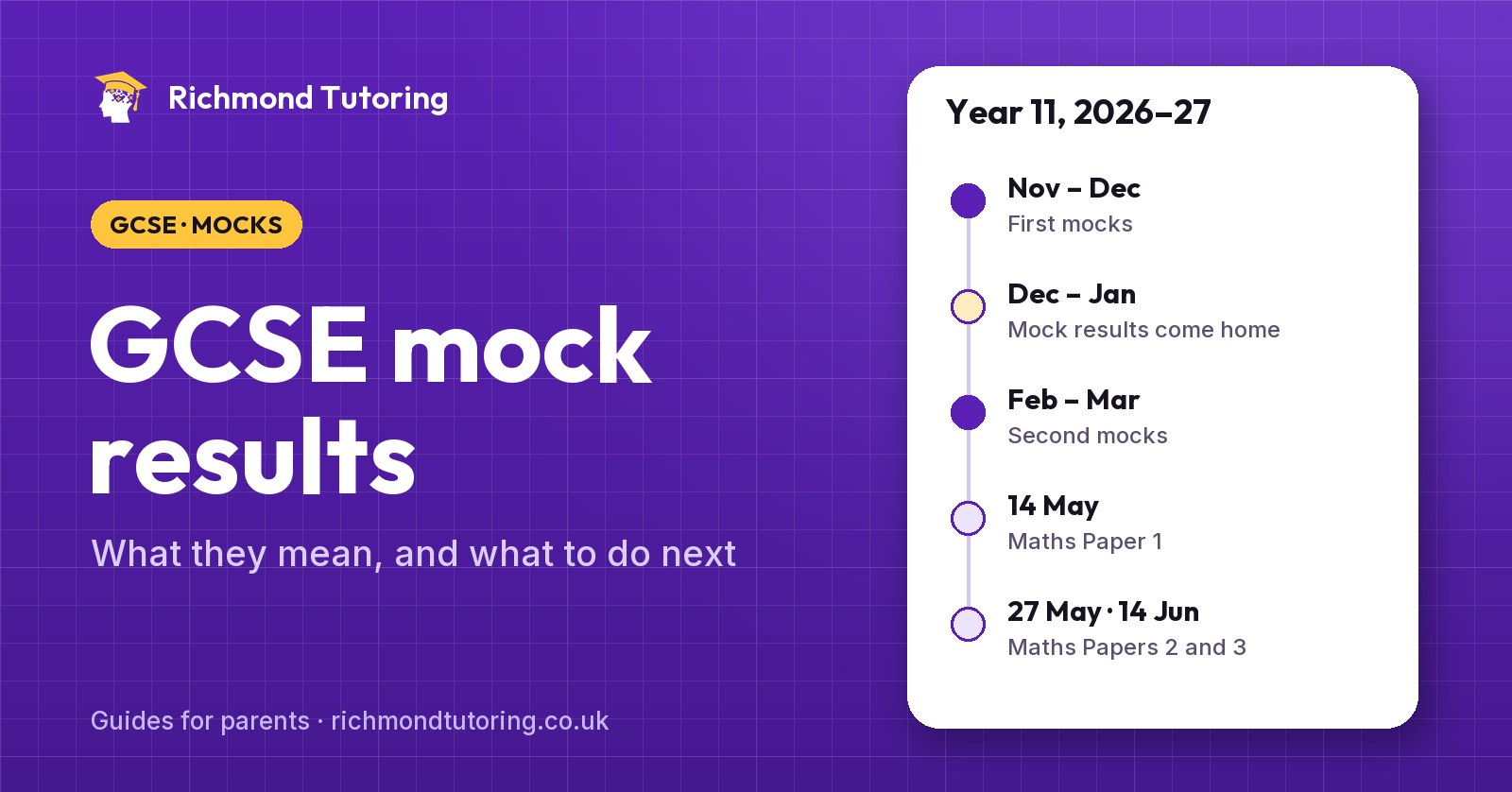
Most schools hold Year 11 mocks in two rounds: the first between November and January, and a second round in February or March. Many also run end-of-year exams in Year 10 that work like a first mock.
| When | What usually happens |
|---|---|
| June to July (Year 10) | End-of-year exams, often called Year 10 mocks |
| November to January (Year 11) | First mocks, usually over two or three weeks |
| A few weeks after the mocks | Results and marked papers come back |
| February to March | Second mocks, closer to the real exams |
| 14 May, 27 May and 14 June 2027 | The real GCSE Maths Papers 1, 2 and 3, mornings (AQA's dates are still provisional) |
Dates vary between schools, so check your child's school calendar. For every subject's summer dates, see GCSE exam dates 2027, and for when marks come back and what they mean, see our guide to GCSE mock results. If the mocks are sooner than six weeks away, use the same plan but start at the week that matches the time left, or use the shorter plans below.
Do mock exams matter?
Mocks don't count towards the final GCSE grade, but schools use them for things that do matter: predicted grades, sixth form and college applications, set changes and the choice between Foundation and Higher. The most useful part of a mock isn't the grade, it's the marked paper, which shows exactly where marks are being lost.
How GCSE Maths papers work
Every exam board sets three papers for each tier. Foundation covers grades 1 to 5 and Higher covers grades 4 to 9 (with a grade 3 allowed).
| Exam board | Papers | Length | Marks per paper | Non-calculator paper |
|---|---|---|---|---|
| AQA | 3 | 1 hour 30 minutes | 80 | Paper 1 |
| Pearson Edexcel | 3 | 1 hour 30 minutes | 80 | Paper 1 |
| OCR | 3 | 1 hour 30 minutes | 100 | Paper 2 (Foundation) and Paper 5 (Higher) |
Any topic can come up on any paper, including the non-calculator one. That matters for revision: number skills without a calculator need practice right through the six weeks, not just the week before Paper 1.
What topics come up in GCSE Maths mocks?
A mock covers the same five content areas as the real exams, though a school may leave out topics not yet taught, so ask the teacher. Our GCSE Maths topics list sets out every topic by tier. The five areas are weighted differently on each tier. The weightings are set by the Department for Education and Ofqual, are the same for every exam board, and apply across a tier's three papers together rather than to each paper.
| Topic area | Foundation | Higher |
|---|---|---|
| Number | 25% | 15% |
| Algebra | 20% | 30% |
| Ratio, proportion and rates of change | 25% | 20% |
| Geometry and measures | 15% | 20% |
| Probability and statistics | 15% | 15% |
Sources: DfE GCSE mathematics subject content and assessment objectives; AQA GCSE Mathematics (8300) subject content.
What this means for revision: on Foundation, half the marks come from number and ratio, so fractions, percentages, ratio and proportion are worth getting secure first. On Higher, algebra alone is almost a third of the marks, so rearranging, solving equations, quadratics and graphs deserve the most time.
What revision actually works
Students often revise by re-reading notes, highlighting or copying out summaries. It feels productive, but it is one of the least effective ways to study. A major review of learning research by Dunlosky and colleagues (2013) rated ten common techniques and found that two stood out:
- Practice testing: answering questions from memory, then checking the answers. In maths, that means doing questions, not reading worked examples.
- Spaced practice: coming back to the same topic several times with gaps in between, rather than doing it all in one go.
Re-reading, highlighting and summarising were rated as having low usefulness. (Science Daily summary of the review.)
For GCSE Maths, a good session looks like this:
- 5 minutes: a few quick questions on topics from earlier weeks (spaced practice).
- 25 to 30 minutes: exam questions on one weak topic, getting harder as they go (practice testing).
- 5 to 10 minutes: mark the answers with the mark scheme and note anything still wrong.
Short and regular beats long and occasional. Three focused 40-minute sessions a week will do more than one three-hour Sunday.
Before you start: find the weak topics
Revising everything equally wastes time. Spend the first few days finding out where the marks are being lost:
- Sit one past paper under timed conditions, ideally a non-calculator paper, and mark it against the official mark scheme. Our guide to GCSE Maths past papers shows where to find them for every board.
- Or take a shorter check. Our free GCSE Maths check takes about 25 minutes and gives an estimated grade with the topics to work on.
- Ask the teacher which topics will be on the mock and which tier your child will sit. If you are unsure about tiers, see Foundation or Higher?
Then sort the lost marks into three groups, because each needs a different fix:
| Where the marks went | What it looks like | The fix |
|---|---|---|
| Topics | Lost marks clustered in a few areas, such as algebra or ratio | Targeted practice on those topics |
| Question type | Fine on short questions, stuck on longer multi-step ones | Worked examples, then similar exam questions |
| Exam technique | Blanks, missing working, misread questions, running out of time | Timed practice and showing every step |
The 6-week GCSE Maths revision plan
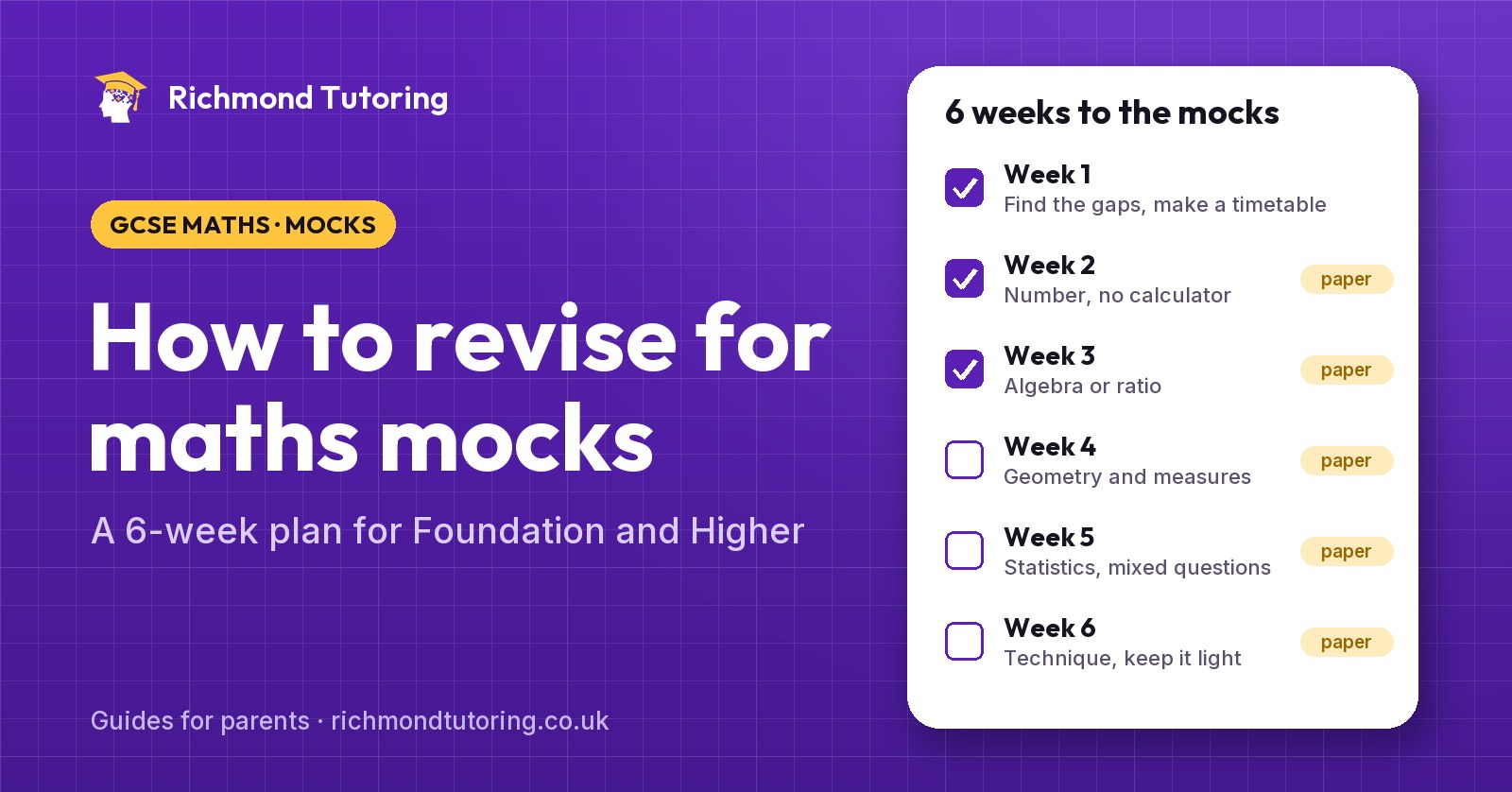
This plan assumes three to five sessions a week of 30 to 45 minutes, plus one timed paper each week from week 2. Adjust it to the time your child has and the topics your starting check found.
| Week | Focus | Timed paper |
|---|---|---|
| 1 | Find the gaps; make a topic list and a revision timetable; start the biggest weak topic | Starting paper or check |
| 2 | Number and non-calculator skills, plus weak topic 1 | One non-calculator paper |
| 3 | Algebra (Higher) or ratio and proportion (Foundation), plus weak topic 2 | One calculator paper |
| 4 | Geometry and measures, plus revisiting weeks 2 and 3 | One calculator paper |
| 5 | Probability and statistics, then mixed questions from every area | One full paper under exam conditions |
| 6 | Exam technique, formulae, the last weak spots; keep the final days light | One final paper early in the week |
Week 1: find the gaps and make a timetable
Sit the starting paper or check, mark it and sort the lost marks into topics, question types and technique. Write a short list of the five or six topics that cost the most. Then plan the sessions for the next five weeks on a simple timetable (see below) and start on the biggest gap.
Week 2: number and non-calculator skills
Non-calculator arithmetic underpins every paper. Practise fractions, decimals, percentages, negative numbers, standard form and estimation without a calculator, then do the first non-calculator paper at the end of the week. Higher students should also cover surds and indices here.
Week 3: the highest-value area for the tier
- Foundation: ratio, proportion, percentages of amounts, percentage change, best buys, speed and simple interest.
- Higher: rearranging formulae, solving equations and inequalities, quadratics, simultaneous equations and straight-line graphs.
Start each session with five minutes on week 2 topics so they don't fade.
Week 4: geometry and measures
Angles, area and perimeter, volume, Pythagoras and trigonometry (both tiers, at different levels), and for Higher, circle theorems, vectors and similar shapes. Keep revisiting algebra or ratio from week 3 at the start of sessions.
Week 5: probability, statistics and mixed practice
Probability, tree diagrams and Venn diagrams, averages and charts (Higher: histograms and cumulative frequency). In the second half of the week, switch to mixed questions from every area. Real papers jump between topics, and practising that switching is part of exam technique. End the week with a full paper in exam conditions: timed, silent, with the right equipment (if the calculator needs replacing, see the best calculator for GCSE Maths).
Week 6: technique and the final week
Use the last paper's lost marks to choose the final few topics. Practise showing every step of working, because method marks are often worth more than the final answer. For exams in 2027, every GCSE Maths paper comes with a formulae sheet, so the skill isn't memorising formulae but knowing which one a question needs. Practise with the sheet your child's board provides (AQA: formulae sheets for 2027). Sit the final paper early in the week, then keep the last two or three days light: a few questions a day, an early night, and the right equipment packed.
Common mistakes to avoid
- No working shown. A wrong answer with clear working can still earn method marks; a bare wrong answer earns none.
- Rounding too early. Keep full values on the calculator and round only at the end.
- Missing units. Check whether the answer needs cm, cm², £ or another unit.
- Calculator in the wrong mode. For trigonometry it must be in degrees. Check it before every paper.
- Not reading the last line. The final line of a question says what is actually being asked, such as the form or accuracy of the answer.
Short on time? A 2-week and 1-week plan
If the mock is closer than six weeks, cut the plan down rather than trying to cover everything.
Two weeks:
- Days 1 to 2: find the gaps with the free GCSE Maths check or one timed past paper.
- Then work on the highest-mark topics for the tier: number and ratio on Foundation, algebra on Higher.
- Sit a timed paper every few days and mark it straight away.
- Spend the last few days on the questions your child got wrong.
One week:
- Sit one diagnostic paper and mark it.
- Pick the three or four weakest topics that carry the most marks and practise exam questions on them.
- Sit one more timed paper midweek.
- The night before: look over the formulae sheet and check the calculator is in degrees mode.
GCSE Maths revision timetable (example week)
A revision timetable doesn't need to be complicated. During term, a realistic week for maths might look like this, alongside revision for other subjects:
| Day | Maths session |
|---|---|
| Monday | 40 minutes: weak topic 1 (questions, then mark) |
| Tuesday | No maths |
| Wednesday | 40 minutes: weak topic 2, starting with 5 minutes on last week's topics |
| Thursday | No maths |
| Friday | 30 minutes: mixed questions |
| Saturday or Sunday | Timed paper (1 hour 30 minutes), then 20 minutes marking it |
Put the sessions at the same times each week, keep phones in another room while working, and build in at least one day off. A timetable the student helps to write is far more likely to be followed than one handed to them. To plan maths alongside every other subject, our free revision timetable maker builds a week-by-week timetable up to the mocks, ready to print.
Foundation and Higher: what to prioritise
| Foundation (grades 1 to 5) | Higher (grades 4 to 9) |
|---|---|
| Fractions, decimals and percentages | Rearranging and solving equations |
| Ratio and proportion | Quadratics: factorising, formula, graphs |
| Area, perimeter and volume | Simultaneous equations |
| Angles and basic geometry | Trigonometry and Pythagoras, including 3D |
| Averages and charts | Circle theorems and vectors |
| Basic algebra: simplifying, expanding, solving | Histograms and cumulative frequency |
| Reading questions carefully and showing working | Multi-step problem-solving questions |
For Foundation students aiming for a grade 4 or 5, our guide on how to pass GCSE Maths Foundation goes into more detail, and what counts as a pass in GCSE Maths explains the difference between a 4 and a 5.
How parents can help
You don't need to know the maths to make a big difference. What helps most is structure, calm and noticing effort.
- Help with the plan, not the maths. Sit down together in week 1 and agree the timetable. Ask what the mock covers and which tier they are sitting.
- Protect the time and space. A quiet place to work, a regular slot and phones out of the room during sessions.
- Ask good questions. "Which questions felt hardest this week?" gets more useful answers than "Have you revised?"
- Notice effort, not just marks. Weekly papers will go up and down. Praise the work and the improvement on specific topics.
- Keep the mock in proportion. It's a rehearsal. A disappointing grade in December is information, with months left to act on it.
- Watch sleep and wellbeing. Late-night cramming does more harm than good, especially in the final week.
- Know when to get help. If the same topics stay weak after two weeks of practice, talk to the maths teacher, or consider a tutor for targeted support (our guide to how much a tutor costs in the UK sets out typical prices).
After the mocks
When the results come back, ask for the marked papers and look at where the marks went rather than the grade alone. Our free GCSE Maths paper analysis does exactly that: a specialist tutor marks the paper and shows which topics and question types cost the most. To turn the marks into an estimated grade, use our GCSE Maths grade calculator, which works from the GCSE grade boundaries. The GCSE mock results guide linked above then sets out a plan from the mocks to the summer exams.
If you would like one-to-one support, our specialist tutors teach GCSE Maths online on your child's exam board, starting from the topics that cost the most marks. You can see how other students have improved on our results page, and book a free 45-minute demo class to get started.