Sometime in Year 11, usually after the first mocks, your child's school will give them a set of predicted GCSE grades. Those grades go on sixth form and college applications, and they can shape which maths and science tier your child sits. Yet most parents are never told how they're worked out. This guide explains what predicted grades are, how schools set them, what they're used for, whether they can change, and what to do if you think one is wrong.
The short answer: A predicted grade is a teacher's professional judgement of the grade your child is likely to get in the summer, based on evidence such as mock exams, tests and classwork. GCSE predictions aren't sent to exam boards and don't affect the final result, but sixth forms and colleges use them to make offers, and schools use them to decide tiers. They can and do change, usually after each round of mocks, so the best way to raise one is to raise the evidence behind it.
What is a predicted grade?
A predicted grade is the grade a teacher expects a student to get in the real GCSE exam if they keep working as they are. It's not a guarantee and it's not an official grade. Each school sets its own process, so the details vary.
Schools often report several kinds of grade, and the names get confused:
| Grade | What it means | Usually based on |
|---|---|---|
| Target grade | The grade the school is aiming for | Prior attainment, often Key Stage 2 SATs, plus national data |
| Working-at grade | The level of the work right now | Recent tests and classwork |
| Predicted grade | The grade expected in the summer exams | Mocks, tests, classwork and the teacher's judgement of progress |
A target grade can stay the same for years, while a predicted grade moves as the evidence changes. A student "working at a 4" in November can reasonably be "predicted a 5" if they're improving quickly and the course isn't finished. If your child's report shows two different numbers, ask the school which is which.
How are predicted grades worked out?
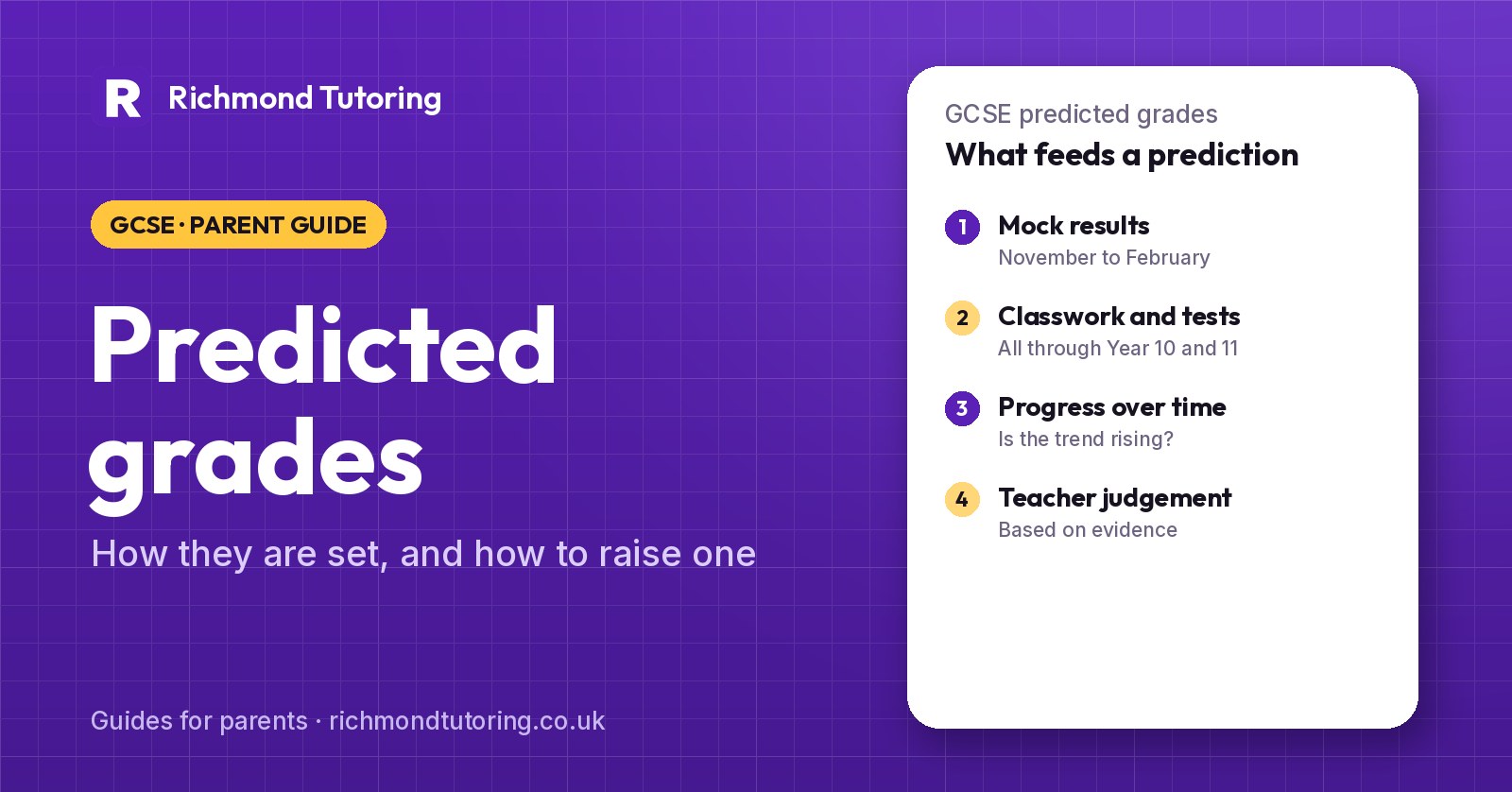
Every school does this differently, but most use the same kinds of evidence:
- Mock exams. These are usually the biggest factor, because they're real past papers marked against the official mark scheme. Our guide to GCSE mock results explains how mocks are graded.
- Topic tests and end-of-unit assessments through Year 10 and Year 11.
- Classwork and homework, especially how consistently the student works.
- The teacher's knowledge of the student: whether they're improving, how they cope under exam conditions, and how much of the course is still to be taught.
Most teachers set predictions from evidence rather than hope. A student promising to "work harder after Christmas" rarely changes a prediction by itself. A strong second mock does.
Mock grades themselves are usually based on an earlier year's grade boundaries. For maths, our guide to GCSE grade boundaries shows what each grade has needed recently, and the free GCSE Maths grade calculator turns paper marks into a grade.
What are predicted grades used for?
Predicted grades don't count towards the final GCSE result. Exam boards grade the real papers on their own. But predictions matter before results day:
- Sixth form and college applications. Applications are usually made in the autumn and winter of Year 11, long before the results. Sixth forms and colleges use predicted grades to decide whether to make an offer, and the offer then depends on the real results in August. Many ask for a 6 or 7 in maths to study A-Level Maths, and similar grades in the sciences.
- Tier entry. In maths and the sciences, schools decide whether a student sits Foundation or Higher. Predictions after the mocks are a big part of that choice, and entries are made in the spring of Year 11. Our guide to Foundation vs Higher explains how tiers work.
- Extra support. Schools often use predictions to decide who gets intervention sessions or revision classes.
- Setting and courses. A prediction can affect which set a student is in, or whether they're offered triple science. Our guide to Triple vs Combined Science covers that choice.
Can predicted grades change?
Yes, and they usually do. Most schools update predictions after each major assessment, so a typical Year 11 has several:
| When | What usually happens |
|---|---|
| Start of Year 11 | Predictions based on end-of-Year-10 exams |
| After the first mocks (December–January) | The most important update, often used for sixth form applications |
| After the second mocks (February–March) | Updated again; tier entries are usually settled around now |
| Before the exams | Final predictions, mainly for the school's own planning |
A prediction can go down as well as up. That isn't a judgement of your child, just a reflection of the latest evidence, and there's usually time to change it.
What to do if you disagree with a predicted grade
If a prediction looks too low, talk to the school calmly and with evidence:
- Ask what it's based on. Request the marked mock papers and the marks on each paper, not just the grade. A single bad paper can drag a prediction down.
- Ask how far off the next grade is. In June 2026 AQA and Edexcel GCSE Maths, most grades were 25 to 40 marks apart across three papers of 80 marks each. That's roughly 8 to 13 marks a paper, a realistic amount to gain by summer.
- Ask when it will next be reviewed and what evidence would change it. Usually the answer is the next mock or test.
- If a sixth form offer depends on it, ask whether the school can mention recent improvement in its reference or application. Some sixth forms will talk to the school directly.
Teachers can't raise a prediction just because a parent asks, and they shouldn't. But they're usually happy to explain how it was set, and to say what would move it.
How to raise a predicted grade
The most reliable way to raise a predicted grade is to raise the evidence behind it, and the next mock is the best chance:
- Get the marked paper and sort the lost marks into topics not known, careless slips, no working shown and questions left blank. Each needs a different fix.
- Fix the biggest topic gaps first, starting with the topics worth the most marks. Our 6-week mock revision plan sets this out week by week.
- Practise full past papers under timed conditions, marked strictly against the mark scheme. Our guide to GCSE Maths past papers lists them for every board.
- Show working on every question. Method marks count even when the final answer is wrong.
- Hand in classwork and homework consistently. Teachers notice, and it all forms part of the evidence.
Want a second opinion? Book a free 45-minute demo class with a specialist tutor — no contract, and an honest view of what your child needs.
Book a free demo classA note on A-Level predicted grades and UCAS
At A-Level, predicted grades matter even more, because they go on the UCAS application and universities make offers from them. UCAS guidance says predictions should be achievable, based on evidence and set by professional judgement, regardless of which universities the student is applying to. They're finalised when the application is sent.
UCAS has also warned that predictions have drifted higher than results. Around half of UK 18-year-olds were predicted AAA or above in 2025, while 26% of accepted applicants actually achieved AAA or above. So a high A-Level prediction is no substitute for the grades themselves. The same advice applies as at GCSE: the end-of-Year-12 exams are usually the key evidence, so treat them as seriously as the real thing.
Want a second opinion on where your child stands?
- The free GCSE Maths check takes 25 minutes and gives an estimated grade and the topics to work on first. It's a useful independent comparison with a school prediction.
- The free GCSE Maths paper analysis: send us papers your child has already sat (a school mock, past papers or exam scripts returned by the school, from any board), and one of our tutors marks every question and sends a report with a predicted grade and a topic breakdown.
- The free GCSE Science quiz takes about 7 minutes: ten questions on your child's board (AQA, Edexcel or OCR), in Combined Science or Biology, Chemistry or Physics, showing which topics are secure and which are gaps.
- A free 45-minute demo class with a GCSE maths tutor or a GCSE science tutor. Tell us the predicted grade and the target when you book, and the tutor will start with the topics that will move it most.
The bottom line
A predicted grade is a teacher's judgement of the likely summer result, built mainly on mocks, tests and classwork. It doesn't count towards the GCSE, but it shapes sixth form offers, tier entries and extra support, so it's worth understanding. Predictions change after each round of mocks, and the way to raise one is to raise the evidence: get the marked paper, fix the biggest gaps and practise under timed conditions before the next assessment.