Years 7, 8 and 9 make up key stage 3 (KS3), and they do more to decide a GCSE Maths grade than most parents realise. Nearly every GCSE topic starts here. This guide sets out what children learn in maths in each of the three years, using the Department for Education's own sample plan, what to expect from tests and sets, and the topics that most often cause trouble later.
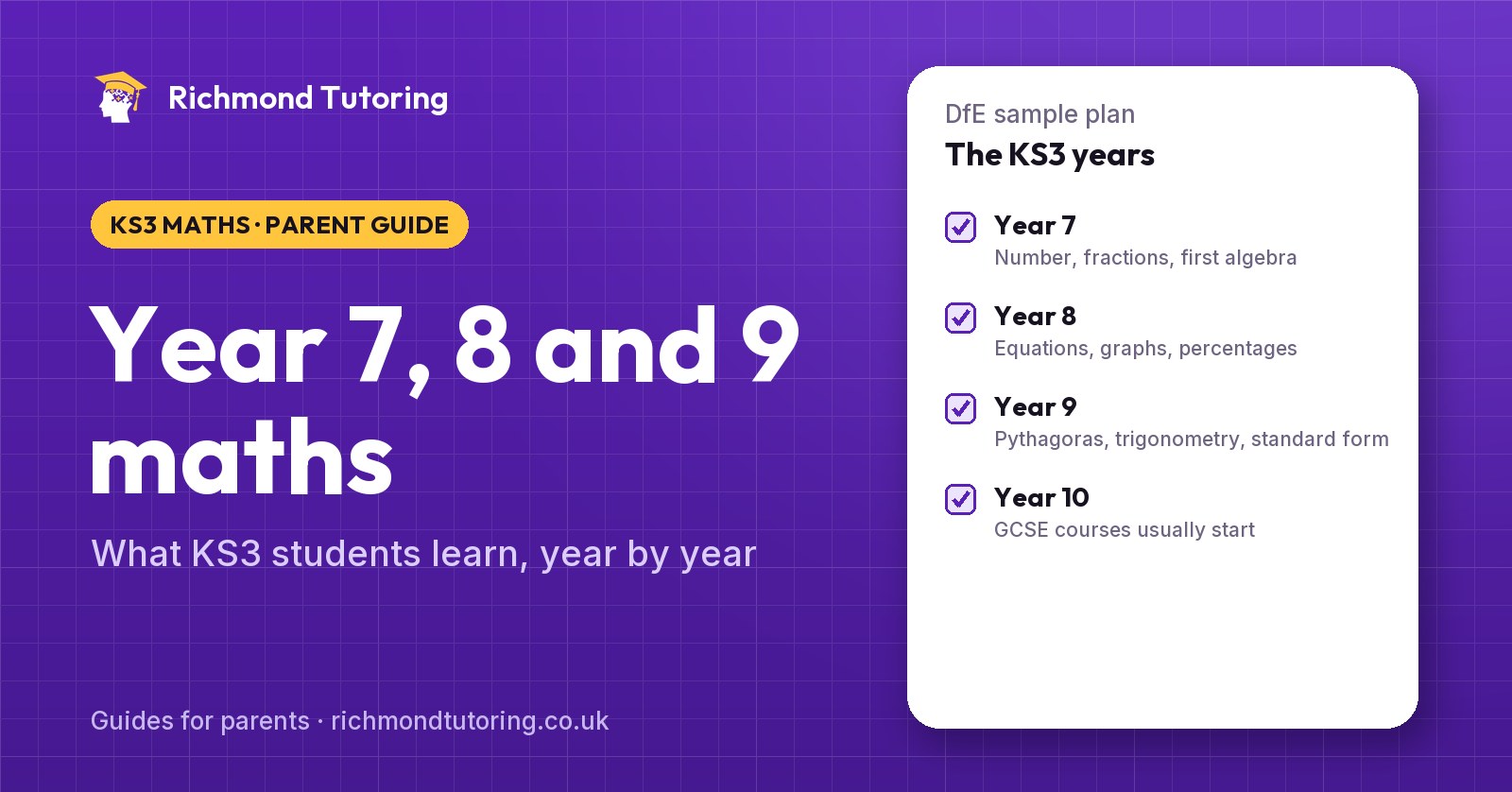
The short answer: KS3 maths covers six areas: number, algebra, ratio and proportion, geometry and measures, probability, and statistics. Schools choose their own order, but the Department for Education's sample plan starts Year 7 with place value, number properties, arithmetic, fractions and simple equations; builds Year 8 around linear graphs, percentages, proportion, statistics, area and angles; and uses Year 9 for Pythagoras, probability, algebraic expressions, trigonometry and standard form. Many schools then start GCSE content in Year 9 or Year 10.
What does the national curriculum say?
The national curriculum for maths at key stage 3 (2013) sets out what must be taught by the end of Year 9. It doesn't say which year each topic goes in. It groups the content into six areas:
| Area | Examples of what's covered by the end of Year 9 |
|---|---|
| Number | Place value, negative numbers, fractions, decimals and percentages, powers and roots, prime factors, rounding and estimation, standard form |
| Algebra | Expressions, brackets, formulae, solving equations, sequences, straight-line graphs, simple quadratic graphs |
| Ratio, proportion and rates of change | Ratio, percentage change, direct and inverse proportion, speed and other rates, scale drawings |
| Geometry and measures | Perimeter, area and volume, angles and polygons, constructions, transformations, similarity, Pythagoras' theorem, trigonometry |
| Probability | Outcomes, probability scales, listing outcomes, combined events, sample spaces and Venn diagrams |
| Statistics | Averages and range, charts and graphs, scatter graphs, comparing data |
Schools put this into a scheme of work (the order they teach topics in), and these differ a lot. Some use published schemes, some write their own. In 2021 the Department for Education published a sample KS3 curriculum framework, written with the NCETM, which recommends taking all three years to build real understanding rather than rushing. The year-by-year lists below follow that sample plan, so your child's school may teach the same topics in a different order.
What do children learn in Year 7 maths?
Year 7 is about making number work secure. A lot of it revisits Year 6 more deeply, which can make it feel easy at first. It isn't wasted time: these ideas carry the rest of secondary maths.
| Term | Topics in the sample plan |
|---|---|
| Autumn | Place value (integers, decimals and measures); factors, multiples, squares, cubes and roots; prime factorisation; written and mental arithmetic with whole numbers and decimals; algebraic expressions, simplifying and expanding brackets |
| Spring | Plotting coordinates; perimeter and area; fractions and decimals, ordering numbers, adding, subtracting, multiplying and dividing fractions |
| Summer | Fractions and ratio as "multiplicative relationships"; transformations: translations, rotations, reflections and enlargements |
Watch for: fractions. Students who aren't confident adding or dividing fractions by the end of Year 7 tend to struggle with ratio, percentages, algebra and probability later. Times tables matter too: slow recall makes every topic harder.
Many schools also set in Year 7, using SATs, a baseline test and often a CAT4 test. Our guide to the Year 7 CAT4 test and maths sets explains how that works.
What do children learn in Year 8 maths?
Year 8 is where algebra and proportion really start. It's also the year when students who coasted through Year 7 can start to slip.
| Term | Topics in the sample plan |
|---|---|
| Autumn | Rounding to decimal places and significant figures, estimating; sequences; straight-line graphs; solving linear equations, including with brackets |
| Spring | Percentages and proportion; statistics: averages and spread, drawing and choosing charts, interpreting data |
| Summer | Perimeter, area and volume; angles in polygons; constructions with a ruler and compasses |
Watch for: equations and percentages. Solving an equation with unknowns on both sides, or working out a percentage increase with a multiplier, are skills that appear on almost every GCSE paper.
What do children learn in Year 9 maths?
Year 9 brings in the topics that feel most like GCSE maths. In schools with a three-year GCSE course, Year 9 is already GCSE.
| Term | Topics in the sample plan |
|---|---|
| Autumn | Similarity and congruence; Pythagoras' theorem; probability of single and combined events |
| Spring | Non-linear sequences; expanding double brackets and rearranging formulae; trigonometry (sine, cosine and tangent) |
| Summer | Standard form; using graphs to model real situations |
Watch for: algebra again. Expanding double brackets and changing the subject of a formula are the bridge to quadratics, which make up a large part of the Higher GCSE paper.
When does GCSE maths start?
It depends on the school. Many teach KS3 for three years and start GCSE courses in Year 10. Others start GCSE content in Year 9, or blend the two from Year 8. Your child's maths teacher or the school website will tell you which.
Either way, Year 9 is when sets and tiers start to matter. By Year 10 most students are working towards either Foundation (grades 1 to 5) or Higher (grades 4 to 9). Our guide to Foundation or Higher GCSE Maths explains the difference.
Are there tests in Years 7, 8 and 9?
There are no national tests in KS3. The Year 9 SATs were scrapped in 2008, although people still search for them. Instead, schools set their own:
- Baseline tests at the start of Year 7, often alongside CAT4.
- Topic or half-termly tests after each unit.
- End-of-year exams, usually in May or June, covering the whole year.
These tests decide sets and give the school its picture of progress. If your child brings home a low end-of-year score, ask for the paper. It shows exactly which topics need work.
Want a second opinion? Book a free 45-minute demo class with a specialist tutor — no contract, and an honest view of what your child needs.
Book a free demo classThe KS3 topics that cause the most trouble at GCSE
From what our tutors see in Year 10 and 11 students, these are the gaps that most often go back to KS3:
- Fractions, especially dividing fractions and fractions of amounts.
- Negative numbers, in calculations and in algebra.
- Percentages with multipliers, such as using 1.05 for a 5% increase.
- Solving equations, especially with brackets or unknowns on both sides.
- Ratio, sharing in a ratio and using ratios with fractions.
- Area and volume formulae, and converting units.
- Expanding and factorising, the basis of quadratics.
Each one takes a few weeks to fix in Year 8, and much longer in Year 11 with ten other subjects to revise.
Is anything changing?
Yes, but not yet. After the government's Curriculum and Assessment Review, a new national curriculum is due to be published by spring 2027 and taught from September 2028. Until then the current KS3 curriculum stays in place. Our guide to GCSE exam dates and what's changing explains which year groups are affected.
How parents can help in KS3
- Ask what the topic is this half term. Most schools publish a curriculum map or knowledge organisers on their website.
- Keep times tables quick. It sounds basic, but it's the single most useful habit for Year 7 and 8.
- Look at test papers, not just scores. A list of the topics lost is more useful than a percentage.
- Act early. A gap found in Year 7 or 8 is quick to fix. The same gap in Year 11 costs marks on every paper.
Want a second opinion on where your child stands?
- The free KS3 Maths check has questions for Years 7 to 9, marked instantly. It shows which year's maths is secure, whether your child is on track for GCSE, and the gaps to close first.
- A free 45-minute demo class with a KS3 maths tutor, who will start from the topics the check or the school's tests found. We also teach KS3 science.
The bottom line
KS3 maths covers number, algebra, ratio, geometry, probability and statistics over three years. Year 7 secures number and fractions, Year 8 builds algebra and proportion, and Year 9 adds Pythagoras, trigonometry and standard form. Schools choose their own order, so check your child's scheme of work. Gaps from these years are the root of most GCSE problems, and they are much easier to close now than in Year 11.