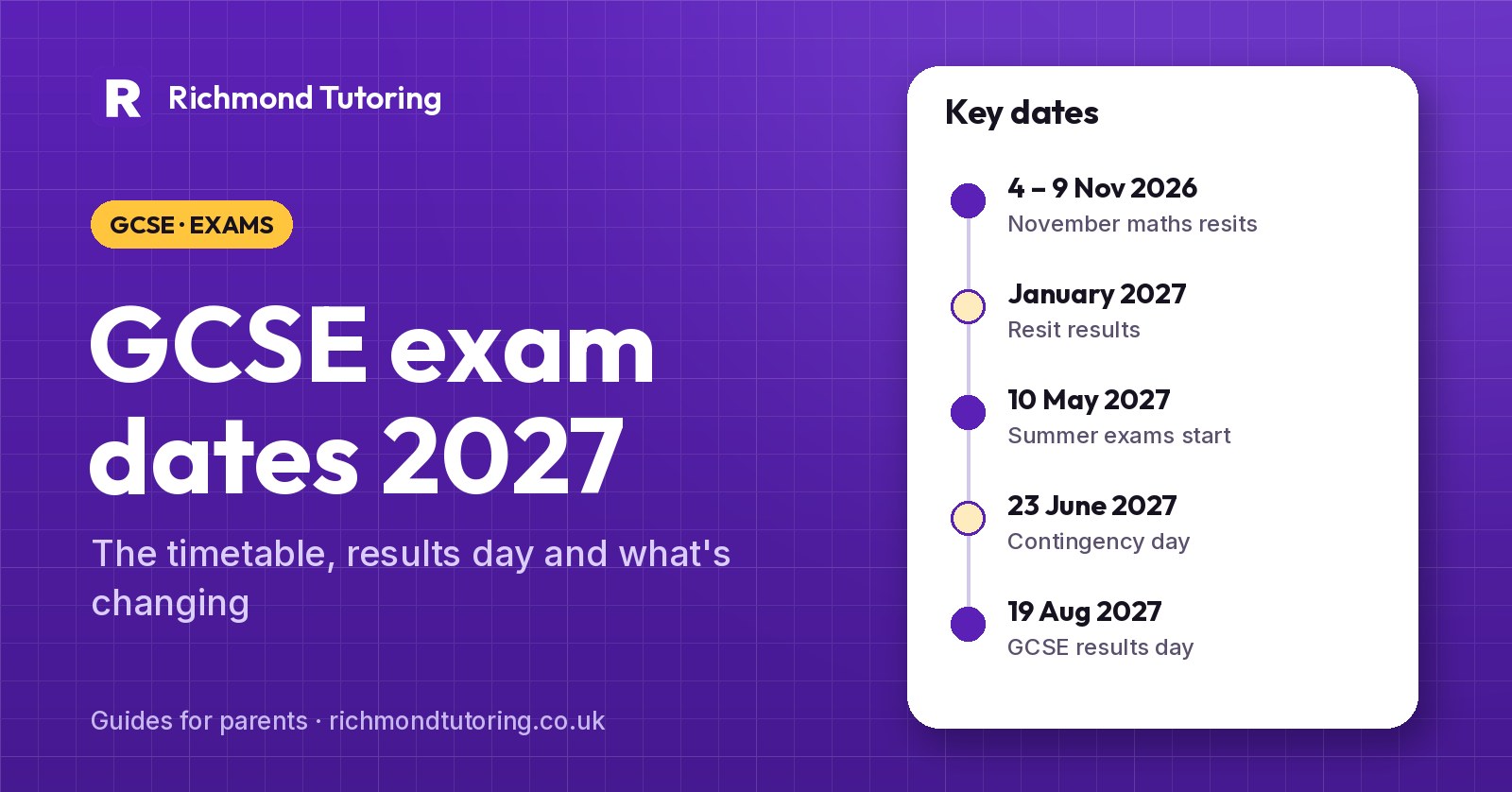
The GCSE exams for this year's Year 11 start on Monday 10 May 2027 and finish on Friday 18 June 2027, with results on Thursday 19 August 2027. This guide lists the key dates for maths, the sciences, computer science and English, explains how the timetable works, and sets out what is (and isn't) changing for students in Years 7 to 11 after the government's curriculum review.
The short answer: GCSE exams in 2027 run from 10 May to 18 June, with a contingency day on Wednesday 23 June. GCSE Maths is on 14 May, 27 May and 14 June for every exam board. Results day is Thursday 19 August 2027. Formula and equation sheets are still provided in maths, physics and combined science, and the big changes from the curriculum review (new GCSEs, shorter exams) don't arrive until the end of the decade.
When do the GCSE exams start and finish in 2027?
All the exam boards in England (AQA, Pearson Edexcel and OCR) follow one common timetable agreed through the Joint Council for Qualifications (JCQ). That's why the maths papers fall on the same days whichever board your child sits.
| Key date | What happens |
|---|---|
| Monday 10 May 2027 | First GCSE exams (including Computer Science Paper 1) |
| Friday 18 June 2027 | Last GCSE exams (including Physics Paper 2) |
| Wednesday 23 June 2027 | Contingency day: kept free in case exams are disrupted nationally |
| Wednesday 18 August 2027 | Results sent to schools and colleges |
| Thursday 19 August 2027 | GCSE results day for students |
Every exam starts at either 9am (morning) or 1:30pm (afternoon), although schools may move the start by up to 30 minutes. Students should keep themselves free until the contingency day, 23 June, in case a paper has to be rescheduled. Pearson Edexcel and OCR have published their final June 2027 timetables, and AQA's timetable uses the same common slots.
For comparison, A-Level results day is a week earlier, on Thursday 12 August 2027.
GCSE Maths 2027 exam dates
GCSE Maths is three papers of 1 hour 30 minutes each, all in the morning:
| Date | AQA (8300) and Pearson Edexcel (1MA1) | OCR (J560) |
|---|---|---|
| Friday 14 May 2027 | Paper 1 (non-calculator) | Paper 1 or 4 (calculator) |
| Thursday 27 May 2027 | Paper 2 (calculator) | Paper 2 or 5 (non-calculator) |
| Monday 14 June 2027 | Paper 3 (calculator) | Paper 3 or 6 (calculator) |
One thing to watch: on OCR, the non-calculator paper is the second one, not the first. If your child sits OCR, plan non-calculator practice for late May.
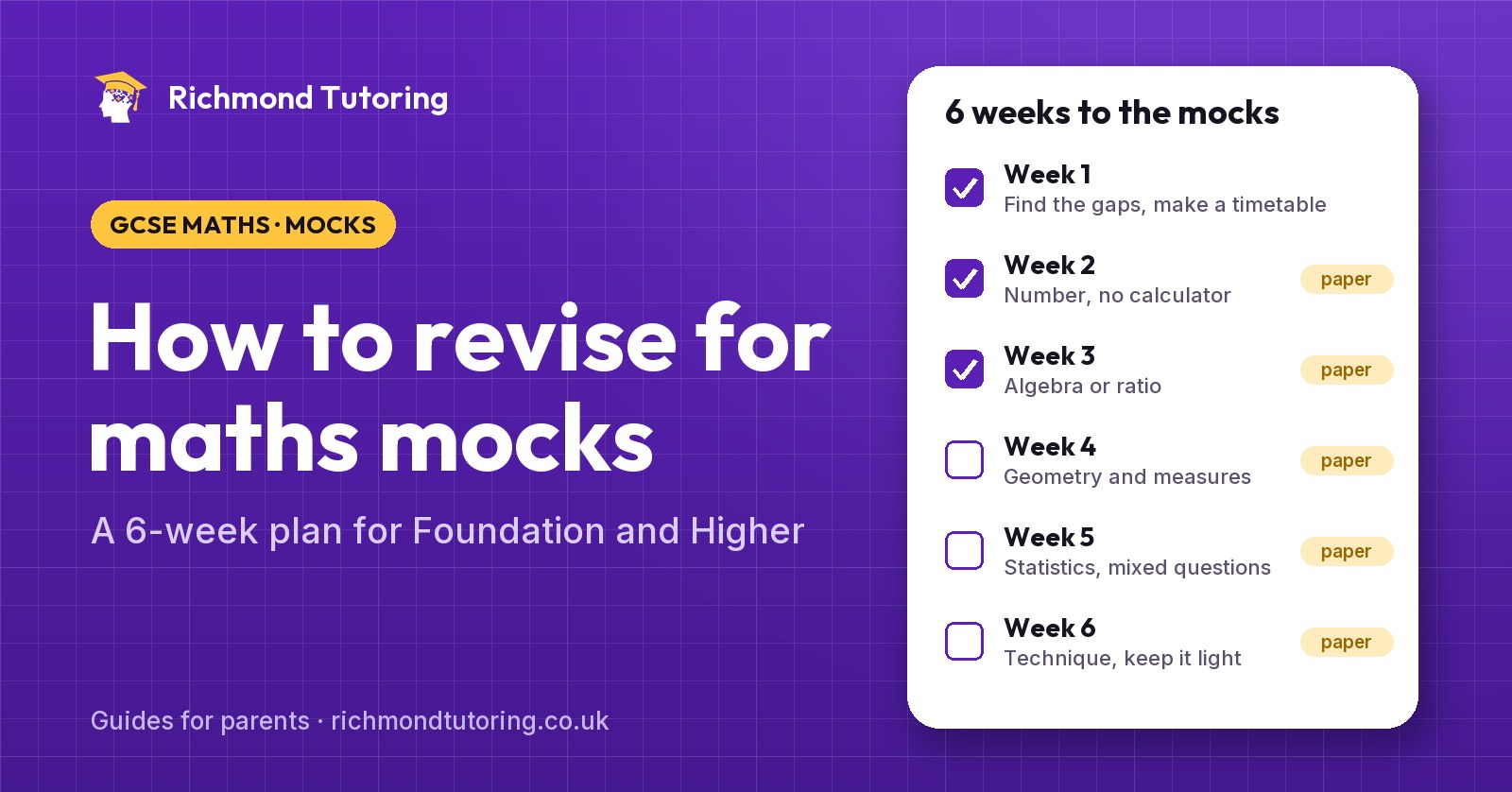
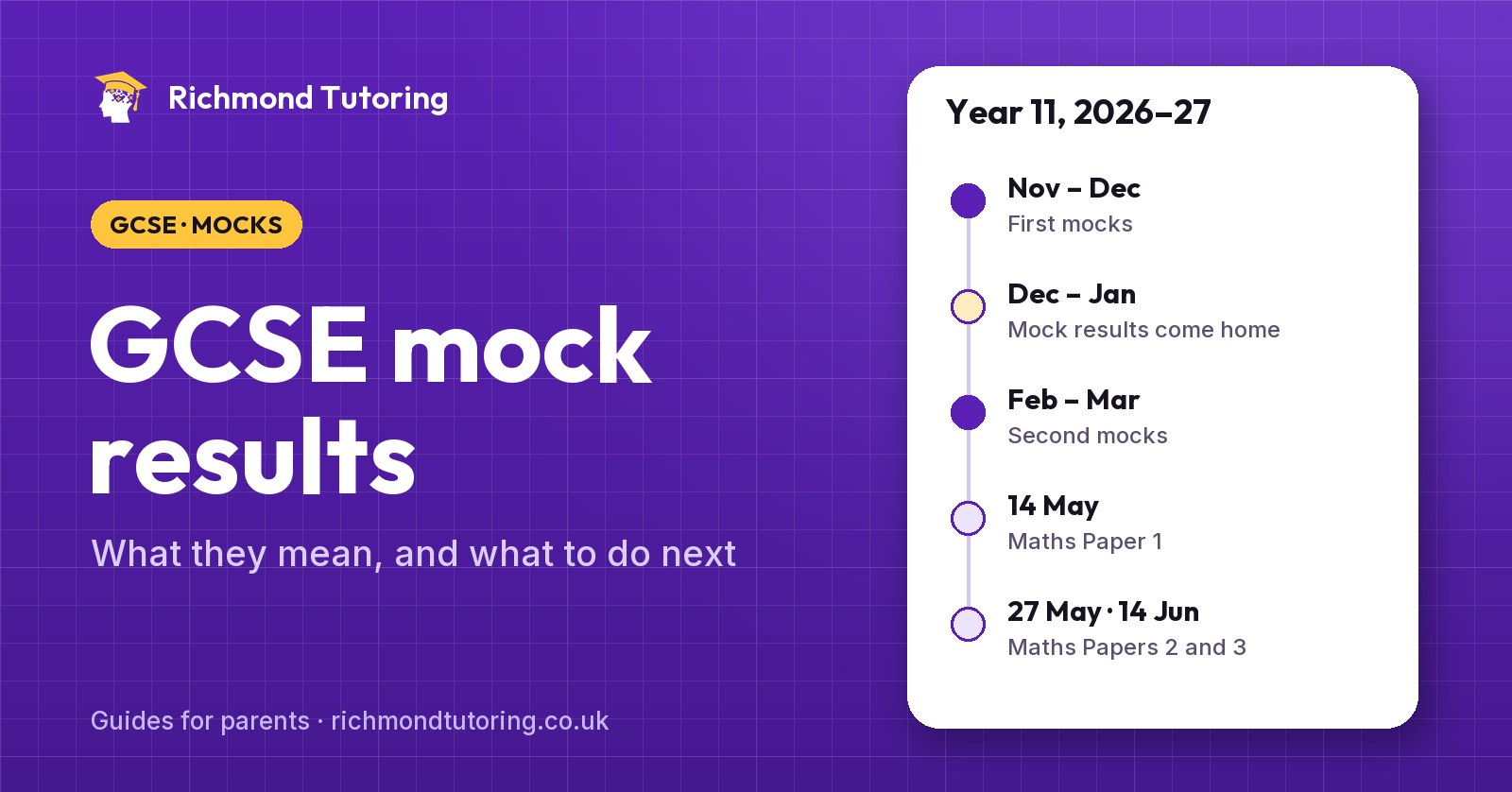
There are about 30 weeks between now and Paper 1, and around 20 between mock results and the exam. Our 6-week mock revision plan and the guide to what mock results mean cover the months before.
GCSE Science 2027 exam dates
Biology, chemistry and physics are timetabled in the same slots whether your child takes the three separate sciences (triple) or Combined Science. All are morning exams:
| Date | Paper |
|---|---|
| Tuesday 11 May 2027 | Biology Paper 1 |
| Monday 17 May 2027 | Chemistry Paper 1 |
| Tuesday 25 May 2027 | Physics Paper 1 |
| Thursday 10 June 2027 | Biology Paper 2 |
| Tuesday 15 June 2027 | Chemistry Paper 2 |
| Friday 18 June 2027 | Physics Paper 2 |
Separate science papers are 1 hour 45 minutes. Combined Science papers are shorter (1 hour 15 minutes on AQA Trilogy and 1 hour 10 minutes on Pearson Edexcel and OCR Gateway). Not sure which your child is taking? Our guide to triple science vs combined science explains the difference.
Computer Science and English 2027 exam dates
| Date | Exam |
|---|---|
| Monday 10 May 2027 (am) | Computer Science Paper 1 |
| Wednesday 12 May 2027 (am) | English Literature Paper 1 |
| Wednesday 19 May 2027 (am) | English Literature Paper 2 |
| Wednesday 19 May 2027 (pm) | Computer Science Paper 2 |
| Monday 24 May 2027 (am) | English Language Paper 1 |
| Tuesday 8 June 2027 (am) | English Language Paper 2 |
On Pearson Edexcel, Computer Science Paper 2 is taken on screen, writing and testing code on a computer.
Half term usually falls in the week of 31 May, so there's a natural break between the first and second halves of the exams. Check your school's own calendar, as term dates vary.
What about the November 2026 resits?
Students who were 16 or older on 31 August 2026 and missed a grade 4 can resit GCSE Maths and English Language in November. The November 2026 maths papers are on 4, 6 and 9 November, and English Language on 3 and 5 November. Results come out in January 2027. Our guide to GCSE Maths resits covers the rules and how to prepare.
Are formula sheets still given in 2027?
Yes. The Department for Education and Ofqual confirmed that students sitting GCSE Maths, Physics and Combined Science in 2025, 2026 and 2027 get a formulae or equations sheet in the exam. The 2027 sheets are the same as 2026, so last year's copies are fine for revision.
Ofqual has since decided that sheets will carry on from 2028 for the rest of the life of the current GCSEs. As AQA explains, one thing changes in the sciences from 2028: questions that only ask students to "write down the equation that links..." will be replaced, because the answer is on the sheet. Maths papers aren't affected.
A sheet isn't a shortcut. Students still need to know which formula to use and how to rearrange it, and that's where most marks are lost. Our GCSE Maths topics list shows which formulae are given and which still need to be learned.
Want a second opinion? Book a free 45-minute demo class with a specialist tutor — no contract, and an honest view of what your child needs.
Book a free demo classWhat's changing in GCSEs after the curriculum review?
In November 2025, the independent Curriculum and Assessment Review published its final report, and the government published its response the same month. The main points for families:
- A new national curriculum is due to be published by spring 2027 and taught in schools from September 2028.
- Updated GCSEs in national curriculum subjects (including maths, the sciences, computing and English) are planned for first teaching in 2029 and 2030, in two groups. A two-year course started in September 2029 would be examined for the first time in 2031.
- Shorter exams. The government plans to cut total exam time by about 2.5 to 3 hours for a typical student taking eight or nine GCSEs. Students currently sit around 24 to 31 hours of exams at the end of Year 11.
- The EBacc measure is gone. The English Baccalaureate headline measure has been removed from school performance tables, starting with the 2025 to 2026 results. Schools no longer have the same pressure to steer students towards a language plus history or geography, although English, maths and science stay at the core.
- Triple science for more students. The government supports a triple science entitlement, so that students who would benefit can take the three separate sciences, with a legal entitlement to follow later. No date has been set.
- Formulae under review. For the new GCSEs, subject experts will look again at whether students should memorise formulae.
- More on-screen exams are being explored, but no subject has been given a date.
None of this changes the GCSEs that today's Year 9, 10 and 11 will sit.
What it means for your child, year by year
| Year group in 2026–27 | GCSE exams in | What to expect |
|---|---|---|
| Year 11 | Summer 2027 | Current GCSEs, dates above, formula sheets provided |
| Year 10 | Summer 2028 | Current GCSEs, formula sheets continue |
| Year 9 | Summer 2029 | Current GCSEs; choosing options this year |
| Year 8 | Summer 2030 | Current GCSEs; the new curriculum starts in their Year 10 |
| Year 7 | Summer 2031 | Likely the first year to sit some of the new GCSEs |
This table assumes a two-year GCSE course starting in Year 10. Some schools start GCSE content in Year 9, and the final timings depend on Ofqual and the exam boards, so treat the later rows as a guide rather than a promise. For Year 9 families, our guide to GCSE options covers the choices coming up in the new year.
Want a second opinion on where your child stands?
- The free GCSE Maths check takes 25 minutes and gives an estimated grade and the topics to work on first.
- The free GCSE Maths grade calculator turns paper marks into a grade on real AQA, Edexcel and OCR boundaries.
- The free GCSE Science quiz takes about 7 minutes: ten questions on your child's board (AQA, Edexcel or OCR), in Combined Science or Biology, Chemistry or Physics, showing which topics are secure and which are gaps.
- The free revision timetable maker builds a week-by-week plan for every subject, weighted towards the ones your child feels least sure of, ready to print.
- For Years 7 to 9, the KS3 Maths check shows whether your child is on track for GCSE.
- A free 45-minute demo class with a GCSE maths tutor or a GCSE science tutor, who'll start from the topics that matter most before May.
The bottom line
GCSE exams in 2027 run from 10 May to 18 June, with the contingency day on 23 June and results on 19 August. Maths falls on 14 May, 27 May and 14 June for every board. For students in Years 9 to 11, the GCSEs and formula sheets stay as they are. The reforms from the curriculum review (a new curriculum from 2028, new GCSEs from 2029 and shorter exams) will mostly affect today's Year 7 and younger. The most useful thing to do now is put the dates in the calendar and work back from them.