Most Year 9 students choose their GCSE options between January and March, often after an options evening and a few weeks to decide. It can feel like a big decision, made at 13 or 14, that shapes what comes next. The good news is that a large part of the timetable is fixed, and most choices keep plenty of doors open. This guide explains what's compulsory, how many subjects to take, the decisions that matter most for later on, and how parents can help without taking over.
The short answer: In England, every student takes English, maths and science at GCSE, and most take eight to ten GCSEs in total. Options usually fill three or four slots. Choose subjects your child enjoys and does well in, keep at least one science route open if medicine, engineering or science is a possibility, and check what A-Levels need before ruling anything out. The EBacc no longer counts in school league tables, so your child has a bit more freedom than older siblings did.
When do GCSE options happen?
In most schools, options are chosen in Year 9:
| When | What usually happens |
|---|---|
| December to January | Options booklet published; taster lessons or assemblies |
| January to February | Options evening for parents and students |
| February to March | Choices submitted, usually with a reserve subject |
| Summer term | Confirmation of subjects (and sometimes sets) |
| September of Year 10 | GCSE courses start |
Some schools start GCSE courses in Year 9 and run options in Year 8 instead, so check your school's calendar. Places on popular courses can be limited, and some schools allocate them partly by the date choices come in, so don't leave the form until the last day.
Which GCSE subjects are compulsory?
The national curriculum sets the core. At key stage 4, every state school must teach:
- Core subjects: English, maths and science. In practice, this means GCSE English Language, usually English Literature, GCSE Maths, and either Combined Science or the three separate sciences.
- Foundation subjects: computing, PE and citizenship. These are taught, but not always as a GCSE.
- Religious education and RSHE. Some schools enter everyone for GCSE Religious Studies; others teach it as a non-exam lesson.
Schools must also offer at least one course in each of the arts, design and technology, humanities (such as history and geography) and modern languages. Whether a subject is compulsory at GCSE beyond the core varies from school to school, so the options booklet is the place to check.
How many GCSEs should my child take?
Most students take eight to ten GCSEs. The government's figures are based on a typical student taking eight or nine. More isn't better: sixth forms and universities look at grades in the right subjects, not the number of GCSEs. A strong set of eight or nine will open more doors than eleven with lower grades.
If your child is finding the core subjects hard, a lighter timetable with extra support in English and maths is often the better choice. A grade 4 in both matters a great deal: students without it carry on studying them after 16, and since young people in England must stay in education or training until 18, it follows them to college or sixth form. Our guide on what a pass in GCSE Maths is explains why.
What happened to the EBacc?
The English Baccalaureate (EBacc) was a school performance measure for students taking English, maths, the sciences, history or geography, and a language. Many schools pushed students towards it. Following the 2025 Curriculum and Assessment Review, the government removed the EBacc measures from performance tables, starting with the 2025 to 2026 results.
For this year's Year 9, schools may relax rules such as "everyone takes a language or history or geography". History, geography and languages are still valuable GCSEs, and some universities like to see a language, but they're no longer something schools are measured on. Ask at options evening whether the school's own rules have changed.
Triple science or combined science?
This is the decision that most affects later options. Combined Science covers biology, chemistry and physics and counts as two GCSEs. Triple (separate) science gives three GCSEs, one in each science, with more content and longer exams.
Both routes lead to A-Level sciences, and many students go on to A-Level Biology, Chemistry or Physics from Combined Science. Triple science is a better preparation for students who are strong in science and maths and are considering science, medicine or engineering. It takes an option slot in many schools, so it comes at the cost of another subject. The government now supports a triple science entitlement, so more schools are likely to offer it in the coming years.
Our guide to triple science vs combined science goes through the pros and cons in detail.
How to choose GCSE options that keep doors open
Few 13-year-olds know what they want to do at 18, and that's fine. A few principles help:
- Choose subjects they enjoy and do well in. Interest drives effort over two years, and effort drives grades. Teachers' reports and Year 9 results are a good guide.
- Look ahead to A-Levels for the big routes. Most medicine courses ask for A-Level Chemistry, and usually Biology or another science. Engineering and physics degrees usually ask for A-Level Maths and often Physics. These routes start with strong GCSE Maths and Science, and triple science helps. Check entry requirements on UCAS for any course your child is considering.
- Think about what each A-Level needs. Many sixth forms ask for a grade 6 or 7 in GCSE Maths for A-Level Maths, and a 6 in the relevant science for A-Level sciences. GCSE Computer Science helps for A-Level Computer Science but is rarely required.
- Balance the timetable. Coursework-heavy subjects (such as art, design and technology, and drama) take a lot of time in Year 11. Two or three of them together can be a lot.
- Don't choose for a teacher or a friend. Teachers change, and friends may be in different sets anyway.
Is GCSE Computer Science a good option?
It's a good choice for students who like problem-solving and maths, and it counts as a strong academic GCSE. It is not the same as using computers: about half the course is programming and algorithms, and the other half is how computers and networks work. Students who struggle with maths sometimes find it harder than expected. If your child is interested, ask whether they've done any coding in Year 9 and how they found it. Our GCSE computer science tutors can give an honest view in a demo class.
Want a second opinion? Book a free 45-minute demo class with a specialist tutor — no contract, and an honest view of what your child needs.
Book a free demo classQuestions to ask at options evening
- Which subjects are compulsory, and how many option slots are there?
- Does triple science take an option slot? How are students chosen for it?
- Has anything changed now the EBacc measure has gone?
- Are maths and science taught in sets, and how is tier entry (Foundation or Higher) decided? Our guide to Foundation vs Higher explains why it matters.
- Which subjects have coursework, and how much?
- What grades do the school's sixth form ask for in each A-Level?
- What happens if a subject is oversubscribed, or if my child wants to change in Year 10?
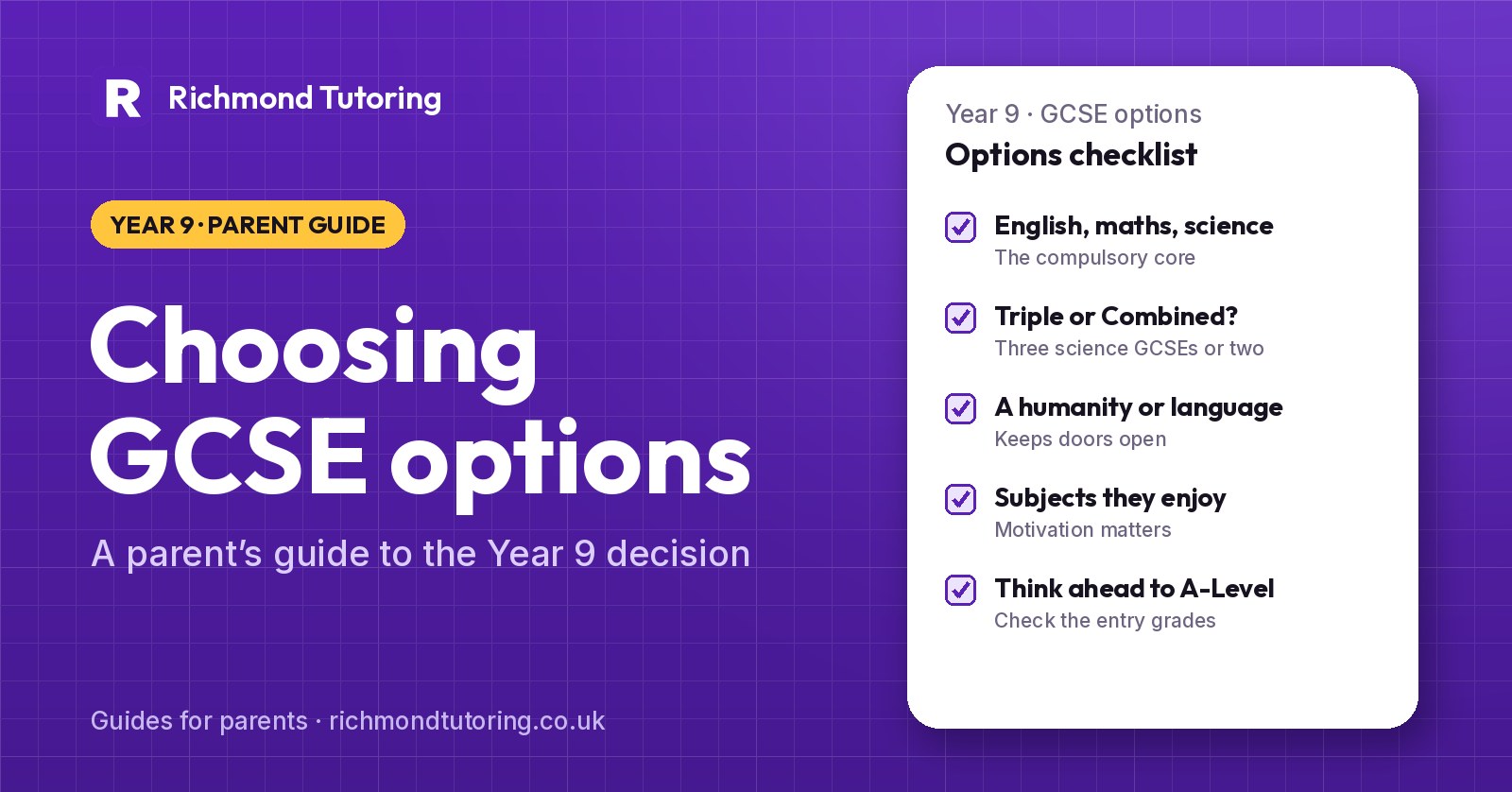
A checklist for parents
- Read the options booklet together, not separately.
- Make a list of subjects your child enjoys, and another of subjects they're good at. Look at where they overlap.
- If a career or degree is in mind, check its A-Level requirements, then the GCSEs those A-Levels need.
- Talk to subject teachers at options evening, especially about subjects your child hasn't studied before.
- Check the balance of coursework and exams.
- Agree a reserve choice in case a subject is full.
- Look at maths and science honestly. If your child is behind now, Year 10 is when gaps start to cost grades.
Want a second opinion on where your child stands?
- The free KS3 Maths check shows whether your child is ready for GCSE maths, with a report on the topics to work on.
- A free 45-minute demo class with a KS3 maths tutor or a KS3 science tutor, to see where your child stands before GCSE courses start.
- Already thinking ahead? Our guide to GCSE exam dates and what's changing explains how the curriculum review affects each year group.
The bottom line
GCSE options are less of a gamble than they feel. English, maths and science are fixed, and most students choose three or four subjects on top. Pick subjects your child enjoys and does well in, keep the science route open if medicine, engineering or science is a possibility, and check A-Level requirements before ruling anything out. With the EBacc measure gone, there's a little more room to choose. Whatever they pick, strong grades in maths and English matter most for every route after 16.