At GCSE, every student in England studies biology, chemistry and physics. The question is how: as Combined Science, which counts as two GCSEs, or as triple science, three separate GCSEs in Biology, Chemistry and Physics. Schools usually decide in Year 9, sometimes as part of GCSE options. This guide explains the difference, whether triple is harder, what each means for A-Levels and university, and how to decide.
The short answer: Combined Science gives two GCSEs and covers about two-thirds of the content; triple science gives three GCSEs and covers it all, with more exam time. Triple is a little harder because there is more to learn, not because the questions are a different kind. Combined Science is accepted for A-Level sciences at most sixth forms, usually at grade 6-6 or 7-7, but check the sixth form your child is aiming for. Triple suits students who enjoy science and are aiming for grade 7 or above.
What is the difference between triple and combined science?
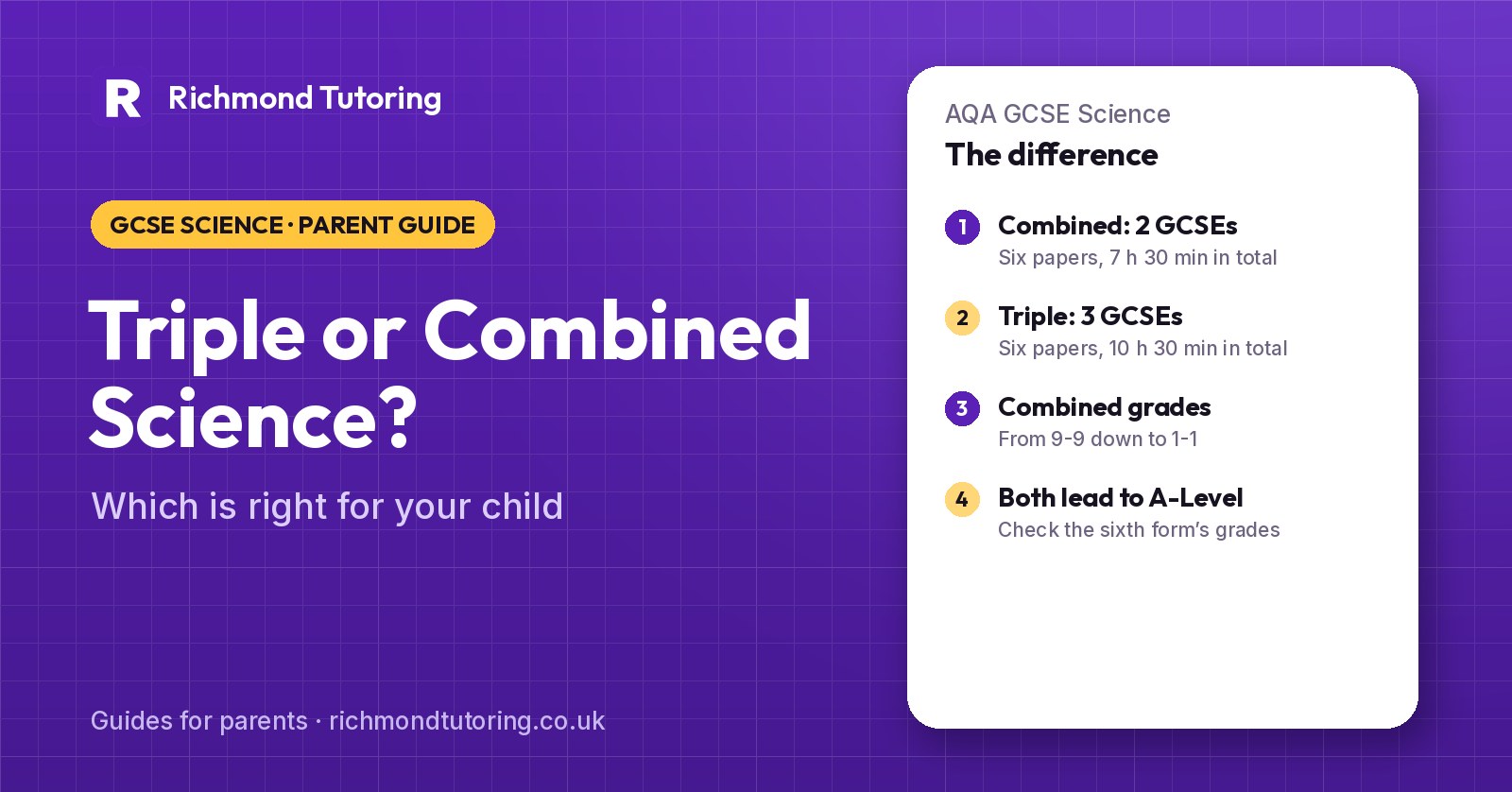
Combined Science (often called double science) covers biology, chemistry and physics in one qualification and is worth two GCSEs. It is graded on a double scale: a student gets two numbers, such as 6-5 or 7-7. The two numbers are always next to each other, and there are 17 grades in total, from 1-1 up to 9-9.
Triple science (also called separate sciences) means three separate GCSEs: Biology, Chemistry and Physics. Each one has its own grade, so a student might get 7 in Biology, 6 in Chemistry and 8 in Physics.
Using AQA, the most common board, as the example:
| Combined Science (AQA 8464) | Triple science (AQA 8461, 8462, 8463) | |
|---|---|---|
| GCSEs | 2 | 3 |
| Grades | One double grade, 1-1 to 9-9 | Three separate grades, 1 to 9 |
| Exams | 6 papers, each 1 hour 15 minutes | 6 papers (2 per science), each 1 hour 45 minutes |
| Total exam time | 7 hours 30 minutes | 10 hours 30 minutes |
| Required practicals | 21 | 28 across the three sciences |
| Tiers | Foundation or Higher, one tier for all six papers | Foundation or Higher, chosen separately for each science |
The figures come from AQA's Combined Science: Trilogy specification and GCSE Biology specification. Pearson Edexcel and OCR have the same structure, two GCSEs or three, with slightly different paper lengths.
How much extra content is in triple science?
Everything in Combined Science is also in the separate sciences, so a triple student learns the whole Combined course and then some. The extra material includes topics such as:
- Biology: more on the brain and the eye, plant diseases and hormones, and cloning.
- Chemistry: more organic chemistry (alcohols, carboxylic acids and polymers), chemical tests for ions, and yield and atom economy.
- Physics: space physics, lenses, sound waves and more on forces and moments.
Each topic is also covered in more depth, and the separate science papers are longer, with more six-mark extended answers. Schools usually teach triple science in the same number of years by giving it more lessons a week, often using one of the GCSE options slots.
Is triple science harder than combined?
Not in the kind of question, but there is more of it. Grade for grade, the questions in triple and combined papers test the same skills: recall, applying ideas to new situations, maths in science and practical skills. What makes triple harder is:
- More content, so more to revise in Year 11.
- Longer exams, which reward stamina and good timing.
- Three grades to protect instead of one double grade. A weak Chemistry paper affects one GCSE rather than pulling down a joint grade.
In practice, many triple students are already strong at science, so it doesn't feel much harder to them. A student who finds science a struggle usually does better on Combined Science, where there is less content and more time to secure each topic.
Which is better for A-Levels?
This is the question most parents are really asking. Combined Science is a perfectly good route into A-Level Biology, Chemistry or Physics. The A-Level courses are designed for students who did either.
What matters more is the grade. Many sixth forms ask for:
- Combined Science: usually 6-6 or 7-7 to study a science at A-Level.
- Triple science: usually a 6 or 7 in the science your child wants to take, and sometimes in a second science too.
Requirements vary, especially for Physics and Chemistry, where some sixth forms also ask for a 6 or 7 in GCSE Maths. Check the entry requirements of the sixth forms or colleges your child is considering. They are normally on the school's website or in the sixth form prospectus.
Triple does give a head start. Students arrive at A-Level having already met topics such as organic chemistry and space physics, so the step up can feel smaller. But a student with a strong Combined grade who works steadily in Year 12 catches up quickly.
Does triple science matter for medicine or university?
Universities look mainly at A-Levels. Where they set GCSE requirements, they usually ask for a number of grades at a certain level, or for specific grades in English, Maths and Science. Combined Science counts as two GCSEs.
Medical, dental and veterinary schools have the strictest GCSE requirements. Most accept Combined Science, but they differ in how they count it and in the grades they ask for. If your child is thinking about medicine, check two or three medical schools' admissions pages in Year 9 or 10. The A-Level Biology and Chemistry grades will matter far more than the type of GCSE science.
How do schools decide who takes triple science?
Schools do it differently:
- Triple for everyone. Some schools, often grammar and independent schools, teach triple science to all students.
- Triple as an option. Students choose it in Year 9, usually in place of one other GCSE option.
- Triple by set. The school puts the top science sets on to triple, based on Year 9 assessments.
- Combined only. Some schools don't offer triple, often because of a shortage of specialist physics teachers.
If your school decides by set, the Year 9 science assessments matter. It is worth asking the science department how the decision is made and when.
Is triple science changing?
Not for current students. Triple science and Combined Science stay as they are for students taking GCSEs in 2027 and the next few years.
In the longer term, the government has accepted the Curriculum and Assessment Review's recommendation of a triple science entitlement. In its response to the review, the Department for Education says it will help schools build a triple science offer "ahead of introducing a statutory entitlement", so that every pupil who can benefit has the chance to take it. The government plans updated GCSEs for first teaching from 2029, so these changes will reach students who are now in primary school or early secondary. Our guide to GCSE exam dates for 2027 covers what is and isn't changing for current students.
How to decide: triple or combined?
Triple science is usually a good choice if your child:
- enjoys science and does well in it, working at grade 6 or above by the end of Year 9;
- is thinking about A-Level sciences, medicine, engineering or another science-based degree;
- is comfortable in maths, because Ofqual's rules say at least 10% of the marks in biology, 20% in chemistry and 30% in physics must test maths skills;
- doesn't mind giving up one other GCSE option, if your school works that way.
Combined Science is usually the better choice if your child:
- finds science hard or is working at grade 4 or 5;
- would rather spend the option slot on a subject they love, such as a language, history or computer science;
- wants a strong double grade rather than three average single grades.
A student with 7-7 in Combined Science is usually in a better position than one with 5, 5 and 4 in the separate sciences. Choose the route where your child is most likely to get good grades.
Want a second opinion? Book a free 45-minute demo class with a specialist tutor — no contract, and an honest view of what your child needs.
Book a free demo classWant a second opinion on where your child stands?
- A free 45-minute demo class with a GCSE science tutor, or a specialist in physics, chemistry or biology. The tutor can tell you whether your child is on track for triple science, or for the grades a sixth form will ask for.
- The free GCSE Science quiz takes about 7 minutes and works for both routes: ten questions on your child's board (AQA, Edexcel or OCR), in Combined Science or Biology, Chemistry or Physics, showing which topics are secure and which are gaps.
- If maths is the worry, the free GCSE Maths check takes 25 minutes and shows the topics to work on first. Maths skills carry a lot of the marks in chemistry and physics.
- Choosing GCSEs this year? Our guide to GCSE options covers the rest of the decision.
The bottom line
Triple science means three GCSEs, more content and three extra hours of exams. Combined Science means two GCSEs graded on a double scale. Both lead to A-Level sciences, and most sixth forms accept a 6-6 or 7-7 in Combined Science. Triple suits students who love science and are aiming high. For everyone else, a strong Combined grade is the better result. Check the entry requirements of the sixth forms your child is considering, ask how your school decides, and pick the route where your child will get their best grades.